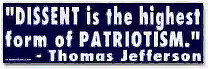
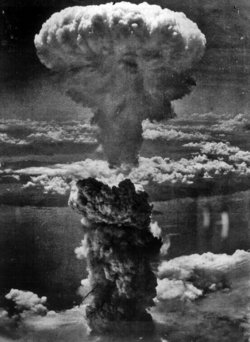
The NeoCons are mad as March hares and must be stopped, whatever it takes!
Why th hell are we protecting a so-called Democracy that insists on being a religious state?
Democratic, religious state is an oxymoron.
What Will We Do Then? The Day After We Strike Iran:
Let us suppose that the Bush-Cheney administration answers the neocons' prayer and does indeed bomb Iran sometime soon.
The plan apparently involves more than the destruction of nuclear facilities, replicating Israel's attack on Iraq's Osirak reactor in 1981. (That attack, by the way was condemned by the whole world, including a furious President Ronald Reagan).
It includes an all-out assault on the Iranian political and religious leadership.
Government buildings and officials' residences will be targeted, guaranteeing collateral damage. Since Iran is a highly complex society, and its government widely unpopular, there may well be some local support for a 'shock and awe' campaign.
We know that the administration has cultivated ties with the Mujahadeen Khalq (even though they remain on the State Department's terrorist list) and the Pakistan-based Balochi separatist group Jundallah (the Party of God). These among other organizations will get their marching orders amid the 'creative chaos' produced by the attack. There can be no large deployment of U.S. troops in Iran, unless they evacuate from Afghanistan and Iraq which is unlikely.
I doubt that administration plans for the construction of a post-attack Iranian polity are any more sophisticated than their plans for post-Taliban Afghanistan or occupied Iraq. Some have suggested that the neocons' goal is actually to plunge the Muslim Middle East into Pandemonium, insuring that all foes of Israel are off-balance and terrorized by the might of Israel's protector for generations to come.
Neocons, writes Paul Craig Roberts, have convinced themselves that nuking Iran will show the Muslim world that the Muslims have no alternative to submitting to the will of the U.S. government.
Thursday, June 21, 2007


Government does NOT want you to visit these 10 websites
Oh Really?
Government does NOT want you to visit these 10 websites | Press Esc:
The US State Department has officially blacklisted the 10 websites listed below as sources of disinformation.
1. Rense Program www.rense.com
2. Roads to Iraq www.roadstoiraq.com
3. Vialls Investigations* www.vialls.com
4. Aljazeera aljazeera.com
5. Conspiracy Planet www.conspiracyplanet.com
6. Jihad Unspun jihadunspun.com
7. International Action Center www.iacenter.org
8. Free Arab Voice www.freearabvoice.org
9. George W. Bush - Terrorist in the White House nogw.com
10. Islam Memo (in Arabic) www.islammemo.cc
*Vialls Investigations is no longer updated as the sites creator, Joe Vialls, died in 2005.
US, Israel finalise Iran strike plan
Oh Christ!
US, Israel finalise Iran strike plan | Press Esc:
Israeli Prime Minister Ehud Olmert visited Washington yesterday and met with US President George W. Bush to finalixe plans for a joint US-Israel strike on Iran's nuclear facilities.
President Bush hinted that actions against Iran will form the core of their discussion.
'I'm sure that we will find some time, also, to discuss other measures, such as the danger of Iran and the threats that come from the President of Iran, who talks time and again about the liquidation of the state of Israel, something that is totally intolerable and unacceptable,' he said. 'And we have to continue the measures taken in order to stop the Iranian efforts to establish unconventional weapons.'
| Amid boos, Pelosi declares Iraq was 'grotesque mistake'
The Raw Story | Amid boos, Pelosi declares Iraq was 'grotesque mistake':
After receiving boos at the liberal Take Back America Conference over the Iraq war, House Speaker Nancy Pelosi (D-CA) reaffirmed her pledge to end the war in Iraq, according to the Capitol Hill newspaper The Hill.
Excerpts:
Pelosi called the war in Iraq a 'tragedy' and a 'grotesque mistake,' but her words elicited catcalls for her to do more. In response, Pelosi acknowledged the protesters and even challenged them..
After receiving boos at the liberal Take Back America Conference over the Iraq war, House Speaker Nancy Pelosi (D-CA) reaffirmed her pledge to end the war in Iraq, according to the Capitol Hill newspaper The Hill.
Excerpts:
Pelosi called the war in Iraq a 'tragedy' and a 'grotesque mistake,' but her words elicited catcalls for her to do more. In response, Pelosi acknowledged the protesters and even challenged them..
FBI knowingly allowed Osama to charter plane after 9/11
If this is true, and it seems to be, where the hell is the investigation?
FBI knowingly allowed Osama to charter plane after 9/11 | Press Esc:
FBI were aware that Osama bin Laden may have chartered one of the flights that took members of the bin Laden family out of the United States immediate after the 9/11 attacks, yet allowed the planes to depart, new Agency documents reveal.
The formerly confidential documents obtained by Judicial Watch through Freedom of Information Act and ongoing litigation states:
ON 9/19/01, A 727 PLANE LEFT LAX, RYAN FLT #441 TO ORLANDO, FL W/ETA (estimated time of arrival) OF 4-5PM. THE PLANE WAS CHARTERED EITHER BY THE SAUDI ARABIAN ROYAL FAMILY OR OSAMA BIN LADEN…THE LA FBI SEARCHED THE PLANE [REDACTED] LUGGAGE, OF WHICH NOTHING UNUSUAL WAS FOUND.
Cigarette taxes may pay for children’s healthcare, to conservatives’ chagrin
This is bullshit, plain and simple.
If we are going to tax "sin," and we have been doing that for as long as I can remember, let's at least start with the "seven deadlies," or the so-called cardinal sins, one of which is greed.
It really wouldn't be so hard to do and the tax revenue would buy the best health-care available for every American, not just children.
As I have often asked, what good does it do to have health care for kids when their parent(s) is/are a mess, physically and psychologically?
TheHill.com - Cigarette taxes may pay for children’s healthcare, to conservatives’ chagrin:
Many senators — including the GOP leader — anticipate bipartisan support for a proposed cigarette-tax hike to help pay for expanding children’s health insurance coverage. But don’t tell that to conservatives.
A small but potentially powerful group of Republicans is vowing to fight any tax increase on principle, even a new tax being eyed to help fund the state children’s health insurance program (SCHIP).
“I’m not in favor of raising taxes, period,” said Sen. Saxby Chambliss (R-Ga.), whose state struggled mightily with unpaid SCHIP bills this year before relief came on the war supplemental.
Chambliss and fellow Republicans make clear that they share Democrats’ desire to cover low-income children. But ideological resistance to new taxes, even on the politically vulnerable tobacco industry, clouds the picture for the new SCHIP bill, which must be finished by September and could cost up to $50 billion.
“It’s incumbent upon us to present options for how you get there, how you fix healthcare, without raising taxes,” Sen. Richard Burr (R-N.C.) said.
If we are going to tax "sin," and we have been doing that for as long as I can remember, let's at least start with the "seven deadlies," or the so-called cardinal sins, one of which is greed.
It really wouldn't be so hard to do and the tax revenue would buy the best health-care available for every American, not just children.
As I have often asked, what good does it do to have health care for kids when their parent(s) is/are a mess, physically and psychologically?
TheHill.com - Cigarette taxes may pay for children’s healthcare, to conservatives’ chagrin:
Many senators — including the GOP leader — anticipate bipartisan support for a proposed cigarette-tax hike to help pay for expanding children’s health insurance coverage. But don’t tell that to conservatives.
A small but potentially powerful group of Republicans is vowing to fight any tax increase on principle, even a new tax being eyed to help fund the state children’s health insurance program (SCHIP).
“I’m not in favor of raising taxes, period,” said Sen. Saxby Chambliss (R-Ga.), whose state struggled mightily with unpaid SCHIP bills this year before relief came on the war supplemental.
Chambliss and fellow Republicans make clear that they share Democrats’ desire to cover low-income children. But ideological resistance to new taxes, even on the politically vulnerable tobacco industry, clouds the picture for the new SCHIP bill, which must be finished by September and could cost up to $50 billion.
“It’s incumbent upon us to present options for how you get there, how you fix healthcare, without raising taxes,” Sen. Richard Burr (R-N.C.) said.
Democrats call Tony Snow's Clinton-era White House e-mail allegations 'untrue'
Liar, Liar Pants on Fire.
Tony, you have enough lying to do about the current administration without taking on the job of lying about the last one.
No one believes a freakin' word you say anyhow.
The Raw Story | Democrats call Tony Snow's Clinton-era White House e-mail allegations 'untrue':
When asked Monday whether officials in the Bush White House had destroyed presidential records by failing to archive e-mails sent over Republican National Committee accounts, Press Secretary Tony Snow said that the current administration's preservation efforts were no different from those used by the administration of Bill Clinton. However, the Democratic National Committee begged to differ.
'That's simply untrue,' Stacie Paxton, a spokeswoman for the Democratic National Committee, told RAW STORY in a Tuesday phone call. 'Clinton White House officials did not have DNC e-mail accounts.'
Paxton was contradicting Tony Snow's remarks in his Monday press conference.
'Those email accounts were set up...on a model based on the prior administration, which had done it the same way, in order to try to avoid Hatch Act violations,' Snow said in his Monday press briefing.
Millions of Missing Birds, Vanishing in Plain Sight - New York Times
We are losing all that which really matters in life!
Millions of Missing Birds, Vanishing in Plain Sight - New York Times:
Last week, the Audubon Society released a new report describing the sharp and startling population decline of some of the most familiar and common birds in America: several kinds of sparrows, the Northern bobwhite, the Eastern meadowlark, the common grackle and the common tern. The average decline of the 20 species in the Audubon Society’s report is 68 percent.
Forty years ago, there were an estimated 31 million bobwhites. Now there are 5.5 million. Compared to the hundred-some condors presently in the wild, 5.5 million bobwhites sounds like a lot of birds. But what matters is the 25.5 million missing and the troubles that brought them down — and are all too likely to bring down the rest of them, too. So this is not extinction, but it is how things look before extinction happens.
New Orleans Still at Risk, Army Data Show
Surprise, surprise.
We should move the White House to N.O for the summer.
New Orleans Still at Risk, Army Data Show - New York Times:
After nearly two years of work, the Army Corps of Engineers revealed yesterday which New Orleans neighborhoods and blocks were the most vulnerable to flooding, and which were the best protected. The report shows that despite considerable improvement, large swaths of the city are still likely to be flooded in a major storm.
If a big hurricane were to hit today — producing flooding with a 1-in-100 chance of occurring in any year — parts of the Gentilly and Lakeview neighborhoods, in the northern half of the city, would probably still take on at least eight feet of water. Hundreds of flooded homes in those neighborhoods are being rebuilt by owners struggling to return.
Bloomberg Buzz: a Winner or a Spoiler?
Neither!
We are going to go out on a limb, here, and predict that he won't run. It would be a huge waste of his own, personal money and even though he has plenty of that, who would want to flush millions down the toilet?
Americans don't tend to like or trust guys with enough money to buy the White House or even the state house.
ABC News: Bloomberg Buzz: a Winner or a Spoiler?:
The possibility of a Mike Bloomberg tilt at the White House raises the two questions that always buzz around independent candidacies: Can he win, and if he can't, could he be a spoiler?
The cautious answer is that anything is possible. But with both history and current data as our guides, neither looks likely.
Scalia: The Jack Bauer Torture Test
Scalia is a fruitcake and a dangerous one, at that!
Daily Kos: Scalia: The Jack Bauer Torture Test:
This is what we have come to: Supreme Court justices citing Hollywood for constitutional principles:
Senior judges from North America and Europe were in the midst of a panel discussion about torture and terrorism law, when a Canadian judge's passing remark - 'Thankfully, security agencies in all our countries do not subscribe to the mantra 'What would Jack Bauer do?' ' - got the legal bulldog in Judge Scalia barking.
The conservative jurist stuck up for Agent Bauer, arguing that fictional or not, federal agents require latitude in times of great crisis. 'Jack Bauer saved Los Angeles. ... He saved hundreds of thousands of lives,' Judge Scalia said. Then, recalling Season 2, where the agent's rough interrogation tactics saved California from a terrorist nuke, the Supreme Court judge etched a line in the sand.
'Are you going to convict Jack Bauer?' Judge Scalia challenged his fellow judges. 'Say that criminal law is against him? 'You have the right to a jury trial?' Is any jury going to convict Jack Bauer? I don't think so.
'So the question is really whether we believe in these absolutes. And ought we believe in these absolutes.'
Reclaiming Citizenship, History, and Faith
Or just flat out lying...
How can anyone at any news outlet defend airing a so-called documentary that is biased as hell and sorely lacking in truth?
Talk To Action | Reclaiming Citizenship, History, and Faith:
Recently I wrote about PBS's decision to carry a Religious Right pseudo-documentary attacking the concept of church-state separation.
PBS's ombudsman, Michael Getler, devoted a column to the controversy on June 15.
There is good news and bad news. Getler admits that the show, 'The Wall of Separation,' is clearly slanted toward opponents of the church-state wall.
The bad news is he defends its airing anyway.
Getler writes, 'The interviews in the film, in terms of time on screen and numbers, seemed to me to tilt clearly in favor of those who see a danger in the 'wall of separation' metaphor used by Jefferson....' He points out that the narrator 'time and again, conveys the theme of this film - that God is the necessary foundation of society's law and government.' Getler even calls the treatment a 'heavy-handed hammering away by the narrator.'
Getler goes off the rails when he tries to defend the program. 'My sense,' he writes, 'is that people can take from this film whatever they wish. It can be a useful reminder of the context of our founding documents and a way of looking at that context - and at the intent of the framers of the First Amendment as assessed in the dominant view of this film - that challenges the more common view....Or it can be viewed as sophisticated propaganda, as some critics already have...
Top Iraqi Officials Growing Restless
And the beat goes on...
Top Iraqi Officials Growing Restless - washingtonpost.com:
BAGHDAD, June 20 -- Iraqi Vice President Adel Abdul Mahdi, a senior Shiite politician often mentioned as a potential prime minister, tendered his resignation last week in a move that reflects deepening frustration inside the Iraqi government with Prime Minister Nouri al-Maliki.
Other senior Iraqi officials have considered resigning in recent weeks over the failures of their government to make progress after more than a year in power, according to Iraqi and U.S. officials.
Green Zone is taking more hits
...and this will, no doubt continue until we leave.
Green Zone is taking more hits - Los Angeles Times:
BAGHDAD — The U.S. military acknowledged Wednesday that insurgents are firing more mortar rounds and rockets into Baghdad's Green Zone, a former haven that now is rocked almost daily by explosions.
At a news conference, Navy Rear Adm. Mark Fox refused to disclose the number of attacks, saying he did not want to 'give the people shooting any indication of how effective they might be.'
But he added, 'There is unquestionably an increasing pattern of attacks against the International Zone. There's no doubt about that.'
In a report this month, U.N. Secretary-General Ban Ki-moon said mortar and rocket attacks on the Green Zone, where the United Nations has its Iraq headquarters, had totaled 17 in March, 30 in April and 39 by May 22.
The attacks have killed at least 26 people since Feb. 19, the report says.
Shiite Rivalries Slash at a Once Calm Iraqi City
Bush's Mess-o-potamia just gets worse by the day.
Shiite Rivalries Slash at a Once Calm Iraqi City - New York Times:
DIWANIYA, Iraq — The Shiite heartland of southern Iraq has generally been an oasis of calm in contrast to Baghdad and the central part of the country, but now violence is convulsing this city. Shiites are killing and kidnapping other Shiites, the police force is made up of competing militias and the inner city is a web of impoverished streets where idealized portraits of young men, killed in recent gun battles with Iraqi and American troops, hang from signposts above empty lots.
Why Isn't Rove In Jail?
He has damaged the institutions of government for years to come, simply because he seems to think that those institutions are there simply to serve his political purposes.
Allegations about Rove
By Josh Marshall
June 15, 2007
A lifelong Republican attorney from Alabama, Dana Jill Simpson, recently came forward and swore out an affidavit alleging Karl Rove’s involvement in the prosecution of former Alabama Gov. Don Siegelman (D). According to Simpson, in 2002, a close associate of Karl Rove’s named William Canary said on a conference call that Rove had told him that he’d gotten the Department of Justice (DoJ) to investigate Siegelman and that he was sure the investigation would eventually take Siegelman out of politics.
Simpson, who was then working for Siegelman’s opponent’s campaign, was on the conference call. And she recalls Canary’s saying “not to worry — that he had already gotten it worked out with Karl and Karl had spoken with the Department of Justice and the Department of Justice was already pursuing Don Siegelman.”
Is the claim true? Was Rove successfully using the DoJ to pursue politics by other means as far back as 2002?
The initial “denials” from Canary and others on the alleged conference call were either feeble, non-responsive or non-existent. As interest in the story heated up last week, the denials firmed up a bit. But they still seemed rather specific and lawyered in their detail.
Then there’s the White House and the Department of Justice.
Had the last five months of revelations never happened, perhaps there’d be no reason for either to deign to deny the charges. But we already have a rather detailed predicate establishing a pattern of political — and specifically Rove’s — interference and inappropriate contacts between the White House political office and Main Justice.
We know that Rove repeatedly passed on complaints to the Justice Department that particular U.S. attorneys were not pressing hard enough on “vote fraud” allegations against Democrats — charges that in every case turned out to be baseless. We also know that Rove passed on complaints in an effort to get particular U.S. attorneys fired.
Given that record, it’s not difficult to believe that he pressed the Justice Department to investigate Siegelman — the Democratic governor of a state Rove had spent a lot of time flipping to the Republicans during the 1990s.
A few journalists have put this question to the DoJ and the White House. Did Rove have any contacts with the DoJ about investigating Siegelman, and did he tell William Canary that Siegelman would be taken care of?
But the White House refuses to answer the question. As does the Department of Justice.
Perhaps the issue here is that the Democrats in Washington won’t press the issue, and thus the press won’t either. And from a political standpoint their position may be understandable, even correct. Siegelman was eventually convicted last year. And he’s set to be sentenced later this month.
There are a number of significant questions about the prosecution, the judge and the trial itself.
But Siegelman may well be guilty as sin. Certainly 12 jurors thought so. And that fact may be enough to scare off Democrats willing to carry a torch for unimpeachable figures like David Iglesias or Carol Lam.
But from the perspective of preserving the rule of law, Siegelman’s guilt or innocence really shouldn’t matter. It can be both. Rove may have been playing games with the Justice Department, getting enemies investigated, and Siegelman may also be guilty.
In other words, the question may not play politically. But we should want to know one way or another whether these allegations about Rove are true.
So who’s going to press this question with the White House and the DoJ? Anyone?
Marshall is editor of talkingpointsmemo.com . His column appears in The Hill each week.
E-mail: jmarshall@thehill.com
(In accordance with Title 17 U.S.C. Section 107, this material is distributed without profit to those who have expressed a prior interest in receiving the included information for research and educational purposes. The Lantern has no affiliation whatsoever with the originator of this article nor is The Lantern endorsed or sponsored by the originator.)
....And The Truth Shall Set Us Free
Trends In American Politics
New politics, new media, new majority
By Brent Budowsky
June 20, 2007
Democrats have an opportunity to build a new governing majority and a realigned national politics with impact as powerful as the coalition of Franklin Roosevelt and the up-tempo patriotism of John Kennedy.
Historic trend waves in American politics include the alienation of Americans from everything Washington, the rise of political independence, the hunger for national unity, the feeling of large numbers of Americans that they are disrespected by political and media elites, and major demographic changes creating new political tides.
Here are the building blocks for the next FDR coalition:
A mobilized base of Democrats is now organizing around the Internet in alliance with progressive radio. Their views now converge with a strong majority of political independents.
Progressives are often demeaned on the three cable news networks, and like women, Hispanics and blacks are largely unrepresented among political show hosts.The progressive Internet is a powerful weapon for message, organization and fundraising, and by November 2008 could empower more than $250 million of fundraising and more than one million electoral volunteers.
As progressive radio and the progressive Internet increasingly empower and support each other, the power of both is heightened and the move into comparatively low-rated cable is inevitable.
Women represent a majority of people, voters and consumers. Hispanics are the largest-growing demographic in America. Blacks represent substantial numbers. Yet women, blacks, Hispanics and progressives are almost completely excluded as political show hosts in a new silent majority whose voice has only begun to be heard.
Political independents increasingly adopt Democratic-leaning positions. The population wave of Hispanics is accompanied by greater Democratic support among Hispanic voters, which only increases with the immigration debate. The Hispanic demographic wave will elect more Democrats to Congress and turn Western electoral votes to Democratic presidential candidates, with growing impact in Florida and ultimately Texas.
Giant majorities agree with Democratic views on global warming, energy policy, gasoline prices and dependence on foreign oil from despotic Middle East sources that create security dangers, consumer rip-offs and pressures for war.
The chronic and widespread shortchanging of wounded troops, veterans and military families who together represent more than 50 million voters, with above average turnout, could be a realigning coup de grâce.It is not enough for Democrats to be slightly better than Republicans. If Democrats speak honorably, courageously and comprehensively as the voice of vets and military families, the moral issue is clear and the realigning power is stunning.
If Democrats advocate a new patriotism based on a just society, where sacrifice and success are fairly shared, the new realignment includes heartland America, men and women of faith, working people and all who believe America should be brought together, lifted up and moving forward in the post-Bush era.
The new politics, new media and new majority are rooted in time-honored values of American idealism, major demographic and population waves, the common values of diverse faiths and communities, and advancing trends of media, technology and political fundraising.
Throughout the 20th century the game-changing presidencies and realigning national politics have always coincided with great transformations in major media that reflected changing culture, opinion and demographics.
The first wave was led by Franklin Roosevelt, who mobilized his party and the nation through breakthrough use of radio for communications and organization.
The second wave was led by John Kennedy, who was the first presidential candidate who rode the tide of television, and not only had the looks and message, but a brilliant father who came from the motion picture industry and led his peers in understanding the political power of television.
The third wave was led by Ronald Reagan, who understood television and motion pictures, used radio presentations brilliantly between 1976 and 1980, and brought together what became the conservative media infrastructure that began with religious broadcasting and culminated in conservative talk radio, Fox News and its imitators today.
The fourth wave has begun, combining massive popular discontent with Bush politics, the view of giant constituencies that they are insulted or ignored by current political and media elites, and the mass migration of these huge voter, audience and consumer blocs to media that respects their interests and values.
The wave has begun, the future is now, the candidates who seize it will prevail, and the next Rupert Murdoch will probably be liberal.
Budowsky was an aide to former Sen. Lloyd Bentsen and to Bill Alexander, then-chief deputy whip of the House. He will contribute three follow-up posts on The Hill’s Pundits Blog about 2008 and the future of politics for the Internet, talk radio and K Street.
(In accordance with Title 17 U.S.C. Section 107, this material is distributed without profit to those who have expressed a prior interest in receiving the included information for research and educational purposes. The Lantern has no affiliation whatsoever with the originator of this article nor is The Lantern endorsed or sponsored by the originator.)
....And The Truth Shall Set Us Free
By Brent Budowsky
June 20, 2007
Democrats have an opportunity to build a new governing majority and a realigned national politics with impact as powerful as the coalition of Franklin Roosevelt and the up-tempo patriotism of John Kennedy.
Historic trend waves in American politics include the alienation of Americans from everything Washington, the rise of political independence, the hunger for national unity, the feeling of large numbers of Americans that they are disrespected by political and media elites, and major demographic changes creating new political tides.
Here are the building blocks for the next FDR coalition:
A mobilized base of Democrats is now organizing around the Internet in alliance with progressive radio. Their views now converge with a strong majority of political independents.
Progressives are often demeaned on the three cable news networks, and like women, Hispanics and blacks are largely unrepresented among political show hosts.The progressive Internet is a powerful weapon for message, organization and fundraising, and by November 2008 could empower more than $250 million of fundraising and more than one million electoral volunteers.
As progressive radio and the progressive Internet increasingly empower and support each other, the power of both is heightened and the move into comparatively low-rated cable is inevitable.
Women represent a majority of people, voters and consumers. Hispanics are the largest-growing demographic in America. Blacks represent substantial numbers. Yet women, blacks, Hispanics and progressives are almost completely excluded as political show hosts in a new silent majority whose voice has only begun to be heard.
Political independents increasingly adopt Democratic-leaning positions. The population wave of Hispanics is accompanied by greater Democratic support among Hispanic voters, which only increases with the immigration debate. The Hispanic demographic wave will elect more Democrats to Congress and turn Western electoral votes to Democratic presidential candidates, with growing impact in Florida and ultimately Texas.
Giant majorities agree with Democratic views on global warming, energy policy, gasoline prices and dependence on foreign oil from despotic Middle East sources that create security dangers, consumer rip-offs and pressures for war.
The chronic and widespread shortchanging of wounded troops, veterans and military families who together represent more than 50 million voters, with above average turnout, could be a realigning coup de grâce.It is not enough for Democrats to be slightly better than Republicans. If Democrats speak honorably, courageously and comprehensively as the voice of vets and military families, the moral issue is clear and the realigning power is stunning.
If Democrats advocate a new patriotism based on a just society, where sacrifice and success are fairly shared, the new realignment includes heartland America, men and women of faith, working people and all who believe America should be brought together, lifted up and moving forward in the post-Bush era.
The new politics, new media and new majority are rooted in time-honored values of American idealism, major demographic and population waves, the common values of diverse faiths and communities, and advancing trends of media, technology and political fundraising.
Throughout the 20th century the game-changing presidencies and realigning national politics have always coincided with great transformations in major media that reflected changing culture, opinion and demographics.
The first wave was led by Franklin Roosevelt, who mobilized his party and the nation through breakthrough use of radio for communications and organization.
The second wave was led by John Kennedy, who was the first presidential candidate who rode the tide of television, and not only had the looks and message, but a brilliant father who came from the motion picture industry and led his peers in understanding the political power of television.
The third wave was led by Ronald Reagan, who understood television and motion pictures, used radio presentations brilliantly between 1976 and 1980, and brought together what became the conservative media infrastructure that began with religious broadcasting and culminated in conservative talk radio, Fox News and its imitators today.
The fourth wave has begun, combining massive popular discontent with Bush politics, the view of giant constituencies that they are insulted or ignored by current political and media elites, and the mass migration of these huge voter, audience and consumer blocs to media that respects their interests and values.
The wave has begun, the future is now, the candidates who seize it will prevail, and the next Rupert Murdoch will probably be liberal.
Budowsky was an aide to former Sen. Lloyd Bentsen and to Bill Alexander, then-chief deputy whip of the House. He will contribute three follow-up posts on The Hill’s Pundits Blog about 2008 and the future of politics for the Internet, talk radio and K Street.
(In accordance with Title 17 U.S.C. Section 107, this material is distributed without profit to those who have expressed a prior interest in receiving the included information for research and educational purposes. The Lantern has no affiliation whatsoever with the originator of this article nor is The Lantern endorsed or sponsored by the originator.)
....And The Truth Shall Set Us Free
The GOP: An Empty Shell
The Party of No Ideas
The astonishing vacuousness of the GOP presidential campaigns.
Paul Waldman June 20, 2007 web only
Two years ago, in a much-discussed cover article for The New Republic called "The Case Against New Ideas," Jonathan Chait argued that Democrats should resist the pleas of pundits to look for their political salvation in new plans and visions. But as the 2008 race gathers speed, it appears to be the Republicans who have abandoned ideas -- new or otherwise -- in a quest for the GOP nomination that has been remarkable in its utter lack of substance, even by the standards of contemporary campaigns.
Think about it this way: Can you think of a single substantive proposal consisting of more than a sentence or two that any of the GOP candidates has made on the campaign trail? I'm not even talking about some lengthy policy paper or plan for overhauling a major sector of government.
But any idea to do something, anything, differently than the Bush administration has?
The closest one can come is the immigration bill that Congress is debating, of which John McCain is a co-sponsor. But one gets the impression that McCain wishes no one would bring it up, at least until the primaries are over and all those pesky nativists have nowhere to go but to the Republican nominee. Is there anything else the Republican candidates are actually proposing to do? Any discernable agenda coming from any of them? Anyone? Anyone? Bueller?
It's true that in practice, "ideas," particularly "new ideas," usually serve mainly as signifiers of change from the way things are currently done. This makes things harder on Republicans, as the party currently in charge of the executive branch. A Democrat can offer a relatively simplistic three-point plan for getting out of Iraq, and it sounds like a new idea. But for a Republican who still supports the war (as they all do, with the exception of Ron Paul), coming up with a "new idea" on Iraq would require some exceptional creativity. And this is not a particularly creative crew.
But one would think they'd come up with something, if nowhere else than on national security. This is where their strength is supposed to lie -- where their knowledge and experience are supposed to keep us all safe. But if anything, on national security the Republicans are even more substance-free than on domestic issues. The national-security discussion coming from the candidates resembles nothing so much as the dominance displays of lower primates ("Ooog! Ooog! Me double Gitmo! Ooog!"). Anyone looking for a serious analysis of our security challenges in the coming years will be sorely disappointed.
Likewise, one struggles to find a domestic issue in which the Republicans display any particular interest. Want to read Mitt Romney's health care plan? Don't worry -- you won't have to stay up all night slogging through mind-numbing details about employer mandates and risk pools.
Here it is, in its entirety:
The health of our nation can be improved by extending health insurance to all Americans, not through a government program or new taxes, but through market reforms.To repeat, that's the sum total of what Romney is offering on health care. And that's coming from the one GOP candidate who actually has experience on health insurance reform.
It isn't just Romney.
The entire "Issues" page of Rudy Giuliani's web site runs to a grand total of 788 words, including headings.
Barack Obama's health care plan alone is over six times as long (not including three pages of footnotes). And Obama is the one who keeps getting flack for being light on substance.
We should acknowledge that, from a political standpoint, there isn't much advantage in offering detailed proposals -- and a 20-page proposal certainly doesn't get you twice the benefit of a 10-page proposal. Political consultants routinely advise candidates against putting out position papers and detailed plans, the logic being that few will decide to vote for you based on the elegance of your blueprint for, say, reforming entitlements, but some people may just vote against you when they find something therein they don't like (helpfully pointed out for them by your opponent).
And one might also point out that Democrats have put a lot of energy into policy proposals in the past, to little discernible political effect (true to form, they've been pumping out the position papers this cycle, with John Edwards leading the way).
But a presidential candidacy has to be driven by some kind of policy rationale, some picture of where the candidate wants to take the government and the country. The level of detail isn't really the point, but you do have to offer the voters some sense of what is supposed to happen when you become president. With the GOP candidates, we get nada.
As with most of the Republicans' problems, this aversion to anything resembling an agenda can be traced in no small part to George W. Bush. Like a Bizarro World King Midas, everything Bush has touched has turned to garbage, with the consequence that the standard Republican agenda is almost irredeemably tainted by its association with the last six years.
Tax cuts? We tried that, and got huge deficits. Gettin' tough with terrorists? Not working out so well. Protecting the family? That song's getting older by the month. Nearly anything a Republican proposes can be answered with, "That's just another version of George W. Bush's plan for [insert issue here]. We don't need more Bush."
So every Republican candidate is probably dreading the moment in the general election debate when the Democratic nominee points to him and says, "If you're looking for four more years of George W. Bush, there's your guy." The clips for the ads have already been chosen: John McCain hugging Bush at a 2004 rally; Giuliani saying "Thank God George W. Bush is our president" at the GOP convention in New York.
According to an internal memo obtained in February by the Boston Globe, the Romney campaign's plan to distinguish their candidate from the president comes down to "intelligence." Hey, if it worked for Adlai Stevenson …
What Republicans have always understood better than their Democratic counterparts is that even though presidential campaigns are won on personality, issues are the vehicle through which personality arguments are made -- or as Mark Schmitt put it, "It's not what you say about the issues, it's what the issues say about you."
Once upon a time, John McCain's support of campaign finance reform communicated that he was a courageous reformer willing to antagonize entrenched interests to clean up the system. In 2000, Al Gore was apparently convinced by his advisors that global warming was a loser of an issue, so he never talked about it, depriving himself of an opportunity to show himself as passionate and visionary. The dynamic works in the negative too: John Kerry's complex position and history on Iraq enabled the "flip-flopper" charge to take hold. In each case, the issue offered voters a concrete way to understand the candidate's character (accurately or otherwise).
The Iowa caucuses are still seven months away, and it's entirely possible that the next few months will see a flurry of policy ideas from the Republican candidates. But in the meantime, GOP voters are being treated to a campaign of truly astounding vacuousness.
Paul Waldman is a senior fellow at Media Matters for America and the author of Being Right is Not Enough: What Progressives Must Learn From Conservative Success
(In accordance with Title 17 U.S.C. Section 107, this material is distributed without profit to those who have expressed a prior interest in receiving the included information for research and educational purposes. The Lantern has no affiliation whatsoever with the originator of this article nor is The Lantern endorsed or sponsored by the originator.)
....And The Truth Shall Set Us Free
The astonishing vacuousness of the GOP presidential campaigns.
Paul Waldman June 20, 2007 web only
Two years ago, in a much-discussed cover article for The New Republic called "The Case Against New Ideas," Jonathan Chait argued that Democrats should resist the pleas of pundits to look for their political salvation in new plans and visions. But as the 2008 race gathers speed, it appears to be the Republicans who have abandoned ideas -- new or otherwise -- in a quest for the GOP nomination that has been remarkable in its utter lack of substance, even by the standards of contemporary campaigns.
Think about it this way: Can you think of a single substantive proposal consisting of more than a sentence or two that any of the GOP candidates has made on the campaign trail? I'm not even talking about some lengthy policy paper or plan for overhauling a major sector of government.
But any idea to do something, anything, differently than the Bush administration has?
The closest one can come is the immigration bill that Congress is debating, of which John McCain is a co-sponsor. But one gets the impression that McCain wishes no one would bring it up, at least until the primaries are over and all those pesky nativists have nowhere to go but to the Republican nominee. Is there anything else the Republican candidates are actually proposing to do? Any discernable agenda coming from any of them? Anyone? Anyone? Bueller?
It's true that in practice, "ideas," particularly "new ideas," usually serve mainly as signifiers of change from the way things are currently done. This makes things harder on Republicans, as the party currently in charge of the executive branch. A Democrat can offer a relatively simplistic three-point plan for getting out of Iraq, and it sounds like a new idea. But for a Republican who still supports the war (as they all do, with the exception of Ron Paul), coming up with a "new idea" on Iraq would require some exceptional creativity. And this is not a particularly creative crew.
But one would think they'd come up with something, if nowhere else than on national security. This is where their strength is supposed to lie -- where their knowledge and experience are supposed to keep us all safe. But if anything, on national security the Republicans are even more substance-free than on domestic issues. The national-security discussion coming from the candidates resembles nothing so much as the dominance displays of lower primates ("Ooog! Ooog! Me double Gitmo! Ooog!"). Anyone looking for a serious analysis of our security challenges in the coming years will be sorely disappointed.
Likewise, one struggles to find a domestic issue in which the Republicans display any particular interest. Want to read Mitt Romney's health care plan? Don't worry -- you won't have to stay up all night slogging through mind-numbing details about employer mandates and risk pools.
Here it is, in its entirety:
The health of our nation can be improved by extending health insurance to all Americans, not through a government program or new taxes, but through market reforms.To repeat, that's the sum total of what Romney is offering on health care. And that's coming from the one GOP candidate who actually has experience on health insurance reform.
It isn't just Romney.
The entire "Issues" page of Rudy Giuliani's web site runs to a grand total of 788 words, including headings.
Barack Obama's health care plan alone is over six times as long (not including three pages of footnotes). And Obama is the one who keeps getting flack for being light on substance.
We should acknowledge that, from a political standpoint, there isn't much advantage in offering detailed proposals -- and a 20-page proposal certainly doesn't get you twice the benefit of a 10-page proposal. Political consultants routinely advise candidates against putting out position papers and detailed plans, the logic being that few will decide to vote for you based on the elegance of your blueprint for, say, reforming entitlements, but some people may just vote against you when they find something therein they don't like (helpfully pointed out for them by your opponent).
And one might also point out that Democrats have put a lot of energy into policy proposals in the past, to little discernible political effect (true to form, they've been pumping out the position papers this cycle, with John Edwards leading the way).
But a presidential candidacy has to be driven by some kind of policy rationale, some picture of where the candidate wants to take the government and the country. The level of detail isn't really the point, but you do have to offer the voters some sense of what is supposed to happen when you become president. With the GOP candidates, we get nada.
As with most of the Republicans' problems, this aversion to anything resembling an agenda can be traced in no small part to George W. Bush. Like a Bizarro World King Midas, everything Bush has touched has turned to garbage, with the consequence that the standard Republican agenda is almost irredeemably tainted by its association with the last six years.
Tax cuts? We tried that, and got huge deficits. Gettin' tough with terrorists? Not working out so well. Protecting the family? That song's getting older by the month. Nearly anything a Republican proposes can be answered with, "That's just another version of George W. Bush's plan for [insert issue here]. We don't need more Bush."
So every Republican candidate is probably dreading the moment in the general election debate when the Democratic nominee points to him and says, "If you're looking for four more years of George W. Bush, there's your guy." The clips for the ads have already been chosen: John McCain hugging Bush at a 2004 rally; Giuliani saying "Thank God George W. Bush is our president" at the GOP convention in New York.
According to an internal memo obtained in February by the Boston Globe, the Romney campaign's plan to distinguish their candidate from the president comes down to "intelligence." Hey, if it worked for Adlai Stevenson …
What Republicans have always understood better than their Democratic counterparts is that even though presidential campaigns are won on personality, issues are the vehicle through which personality arguments are made -- or as Mark Schmitt put it, "It's not what you say about the issues, it's what the issues say about you."
Once upon a time, John McCain's support of campaign finance reform communicated that he was a courageous reformer willing to antagonize entrenched interests to clean up the system. In 2000, Al Gore was apparently convinced by his advisors that global warming was a loser of an issue, so he never talked about it, depriving himself of an opportunity to show himself as passionate and visionary. The dynamic works in the negative too: John Kerry's complex position and history on Iraq enabled the "flip-flopper" charge to take hold. In each case, the issue offered voters a concrete way to understand the candidate's character (accurately or otherwise).
The Iowa caucuses are still seven months away, and it's entirely possible that the next few months will see a flurry of policy ideas from the Republican candidates. But in the meantime, GOP voters are being treated to a campaign of truly astounding vacuousness.
Paul Waldman is a senior fellow at Media Matters for America and the author of Being Right is Not Enough: What Progressives Must Learn From Conservative Success
(In accordance with Title 17 U.S.C. Section 107, this material is distributed without profit to those who have expressed a prior interest in receiving the included information for research and educational purposes. The Lantern has no affiliation whatsoever with the originator of this article nor is The Lantern endorsed or sponsored by the originator.)
....And The Truth Shall Set Us Free
Wednesday, June 20, 2007
Hear ye, Hear Ye
This Web site is designed to receive on a completely confidential basis any information concerning the possible politicization of the United States Department of Justice since 2001.
The incoming communications should be limited to those who represent that they are or were employed by the Department of Justice during that period. The communications will be received and reviewed by a select group of members of the majority staff of the Judiciary Committee of the United States House of Representatives. The staff will verify through official directories that the sender is or was an employee of the Department of Justice. The names, titles and identities of the senders will be maintained in strictest confidence, but once the identities are confirmed, the substantive information provided will be utilized for official Committee business, to the extent that it can be verified and confirmed.
This Web site has been created in response to numerous requests by current or former career attorneys of the Department of Justice who have advised Members and staff of the House Judiciary Committee that they are concerned that the Department has become unduly politicized in pursuing its important law enforcement functions. These concerns were underscored by, but predated the firings of at least nine United States Attorneys in the second half of 2006. The concerns are voiced by lawyers in various divisions of Main Justice, including but not limited to, the Criminal Division and the Civil Rights Division and by assistant United States attorneys throughout the country.
At the same time, many individuals have expressed concerns that their identities be kept confidential from political appointees within the Department out of a concern for retribution, which could include termination, demotions or other adverse employment actions. In order to prevent such unfortunate retaliatory actions, we recommend that Departmental e-mail not be used for this purpose.
We recommend that current or former employees use personal e-mail to this Web site or call or write the staff of the Committee at the following address or telephone number: 2138 Rayburn House Office Building, Washington, DC 20515. (202) 225 3951.
While anonymous messages will not be considered, similar confidentiality will apply to anyone identifying him or herself and requesting such confidentiality. The Committee is looking for concrete and specific actions taken or statements made by management-level officials of the Department that have led career employees to be concerned that law enforcement actions will not be handled on a completely non-partisan, impartial manner but will be unduly influenced by partisan political or other inappropriate considerations.
The information supplied and verified will be included in matters that are investigated by the Committee and will be incorporated in the Committee’s reports and in legislative and oversight activities of the Committee. We appreciate your cooperation and assistance and look forward to any valid information that current or former DOJ employees can provide.
(In accordance with Title 17 U.S.C. Section 107, this material is distributed without profit to those who have expressed a prior interest in receiving the included information for research and educational purposes. The Lantern has no affiliation whatsoever with the originator of this article nor is The Lantern endorsed or sponsored by the originator.)
....And The Truth Shall Set Us Free
The incoming communications should be limited to those who represent that they are or were employed by the Department of Justice during that period. The communications will be received and reviewed by a select group of members of the majority staff of the Judiciary Committee of the United States House of Representatives. The staff will verify through official directories that the sender is or was an employee of the Department of Justice. The names, titles and identities of the senders will be maintained in strictest confidence, but once the identities are confirmed, the substantive information provided will be utilized for official Committee business, to the extent that it can be verified and confirmed.
This Web site has been created in response to numerous requests by current or former career attorneys of the Department of Justice who have advised Members and staff of the House Judiciary Committee that they are concerned that the Department has become unduly politicized in pursuing its important law enforcement functions. These concerns were underscored by, but predated the firings of at least nine United States Attorneys in the second half of 2006. The concerns are voiced by lawyers in various divisions of Main Justice, including but not limited to, the Criminal Division and the Civil Rights Division and by assistant United States attorneys throughout the country.
At the same time, many individuals have expressed concerns that their identities be kept confidential from political appointees within the Department out of a concern for retribution, which could include termination, demotions or other adverse employment actions. In order to prevent such unfortunate retaliatory actions, we recommend that Departmental e-mail not be used for this purpose.
We recommend that current or former employees use personal e-mail to this Web site or call or write the staff of the Committee at the following address or telephone number: 2138 Rayburn House Office Building, Washington, DC 20515. (202) 225 3951.
While anonymous messages will not be considered, similar confidentiality will apply to anyone identifying him or herself and requesting such confidentiality. The Committee is looking for concrete and specific actions taken or statements made by management-level officials of the Department that have led career employees to be concerned that law enforcement actions will not be handled on a completely non-partisan, impartial manner but will be unduly influenced by partisan political or other inappropriate considerations.
The information supplied and verified will be included in matters that are investigated by the Committee and will be incorporated in the Committee’s reports and in legislative and oversight activities of the Committee. We appreciate your cooperation and assistance and look forward to any valid information that current or former DOJ employees can provide.
(In accordance with Title 17 U.S.C. Section 107, this material is distributed without profit to those who have expressed a prior interest in receiving the included information for research and educational purposes. The Lantern has no affiliation whatsoever with the originator of this article nor is The Lantern endorsed or sponsored by the originator.)
....And The Truth Shall Set Us Free
Rudy is a Gansta!!!
Guiliani’s SC Campaign Chairman Indicted
By: Nicole Belle on Wednesday, June 20th, 2007 at 11:32 AM - PDT
This “bad boy buddy getting in trouble” is becoming a regular thing with Rudy…
Palmetto Scoop:
The South Carolina Law Enforcement Division has just announced that State Treasurer Thomas Ravenel has been indicted by federal jury on cocaine distribution charges. Ravenel, who was elected last fall, was named the Chairman of presidential candidate Rudy Giualiani’s (R-N.Y.) South Carolina campaign in April.
(In accordance with Title 17 U.S.C. Section 107, this material is distributed without profit to those who have expressed a prior interest in receiving the included information for research and educational purposes. The Lantern has no affiliation whatsoever with the originator of this article nor is The Lantern endorsed or sponsored by the originator.)
....And The Truth Shall Set Us Free
By: Nicole Belle on Wednesday, June 20th, 2007 at 11:32 AM - PDT
This “bad boy buddy getting in trouble” is becoming a regular thing with Rudy…
Palmetto Scoop:
The South Carolina Law Enforcement Division has just announced that State Treasurer Thomas Ravenel has been indicted by federal jury on cocaine distribution charges. Ravenel, who was elected last fall, was named the Chairman of presidential candidate Rudy Giualiani’s (R-N.Y.) South Carolina campaign in April.
(In accordance with Title 17 U.S.C. Section 107, this material is distributed without profit to those who have expressed a prior interest in receiving the included information for research and educational purposes. The Lantern has no affiliation whatsoever with the originator of this article nor is The Lantern endorsed or sponsored by the originator.)
....And The Truth Shall Set Us Free
Subscribe to:
Posts (Atom)