Showing posts with label Condi Rice. Show all posts

Friday, July 20, 2007

Cheadle and Condi

Don Cheadle Goes Off on Condi

cheadle_071107_FRESH.jpg

CONDI-SCENDING
Cheadle
(Photo: Getty Images)


Ubiquitous actor Don Cheadle shared an insider's view of the State Department Tuesday evening, while taking questions at a New York screening of his new film Talk to Me (out Thursday), presented by the Film Society of Lincoln Center. Asked about his reported disappointment in George W. Bush's Sudan policy, the actor quipped: "Can you turn that camera off?! ... I didn't say it. She did!"

Cheadle, co-author of Not On Our Watch, about the genocide in Darfur, was recently called in to talk to Secretary of State Condoleezza Rice about the issue. And he wasn't impressed.

"She wanted to tell me what the U.S. was doing," Cheadle said. "First she said, 'We're doing all we can, but it's not us, it's the United Nations. They're bogged down with red tape, and trying to push anything through just takes forever. The bureaucracy is almost insurmountable, and it's the United Nations, not the U.S.' And then she said, 'It's like when we had this crisis in Lebanon, I had to send someone down specifically to push through all of our legislation and make sure that everything moved through efficiently.' I'm thinking, I thought you had no control over the United Nations. But I didn't say that, 'cause I wanted to leave!"

The audience erupted in laughter.

"And then she basically said, 'And I've heard a lot of you activists talking about George Bush needs to do more to stop the crisis in Darfur, and George Bush can't stop this crisis in Darfur. You guys need to back off of that.'"

The actor did eventually return to the subject of Bush. "Look, he's been hoisted on his own petard. I don't have to say anything about him. Everybody knows what's up with him."


(In accordance with Title 17 U.S.C. Section 107, this material is distributed without profit to those who have expressed a prior interest in receiving the included information for research and educational purposes. The Lantern has no affiliation whatsoever with the originator of this article nor is The Lantern endorsed or sponsored by the originator.)

....And The Truth Shall Set Us Free

Monday, July 16, 2007

Rice Loses out to Cheney, as Cheney Pushes for War with Iran

We all lose, period.

This was highly predictable. Rice going up against Cheney is like Lil Orphan Annie going up against Freddie Krueger.

Cheney Pushes Bush to Act on Iran

Military solution back in favor as Rice loses out - President 'not prepared to leave conflict unresolved' (What freakin' conflict? The one in Cheney's head?)

The balance in the internal White House debate over Iran has shifted back in favor of military action before President George Bush leaves office in 18 months, the Guardian has learned.

The shift follows an internal review involving the White House, the Pentagon and the state department over the last month. Although the Bush administration is in deep trouble over Iraq, it remains focused on Iran. A well-placed source in Washington said: "Bush is not going to leave office with Iran still in limbo."

The White House claims that Iran, whose influence in the Middle East has increased significantly over the last six years, is intent on building a nuclear weapon and is arming insurgents in Iraq and Afghanistan.

The vice-president, Dick Cheney, has long favoured upping the threat of military action against Iran. He is being resisted by the secretary of state, Condoleezza Rice, and the defence secretary, Robert Gates.

Last year Mr Bush came down in favour of Ms Rice, who along with Britain, France and Germany has been putting a diplomatic squeeze on Iran. But at a meeting of the White House, Pentagon and state department last month, Mr Cheney expressed frustration at the lack of progress and Mr Bush sided with him. "The balance has tilted. There is cause for concern," the source said this week.

Nick Burns, the undersecretary of state responsible for Iran and a career diplomat who is one of the main advocates of negotiation, told the meeting it was likely that diplomatic maneuvering would still be continuing in January 2009. That assessment went down badly with Mr Cheney and Mr Bush.

"Cheney has limited capital left, but if he wanted to use all his capital on this one issue, he could still have an impact," said Patrick Cronin, the director of studies at the International Institute for Strategic Studies.

The Washington source said Mr Bush and Mr Cheney did not trust any potential successors in the White House, Republican or Democratic, to deal with Iran decisively. They are also reluctant for Israel to carry out any strikes because the US would get the blame in the region anyway.

"The red line is not in Iran. The red line is in Israel. If Israel is adamant it will attack, the US will have to take decisive action," Mr Cronin said. "The choices are: tell Israel no, let Israel do the job, or do the job yourself."

Almost half of the US's 277 warships are stationed close to Iran, including two aircraft carrier groups. The aircraft carrier USS Enterprise left Virginia last week for the Gulf. A Pentagon spokesman said it was to replace the USS Nimitz and there would be no overlap that would mean three carriers in Gulf at the same time.

No decision on military action is expected until next year. In the meantime, the state department will continue to pursue the diplomatic route.

Sporadic talks are under way between the EU foreign policy chief, Javier Solana, and Iran's top nuclear negotiator, Ali Larijani, on the possibility of a freeze in Iran's uranium enrichment programme. Tehran has so far refused to contemplate a freeze, but has provisionally agreed to another round of talks at the end of the month.

The head of the International Atomic Energy Agency, Mohamed ElBaradei, has said that there are signs of Iran slowing down work on the enrichment plant it is building in Natanz. Negotiations took place in Tehran last week between Iranian officials and the IAEA, which is seeking a full accounting of Iran's nuclear activities before Tehran disclosed its enrichment program in 2003. The agency's deputy director general, Olli Heinonen, said two days of talks had produced "good results" and would continue.

At the UN, the US, Britain and France are trying to secure agreement from other security council members for a new round of sanctions against Iran. The US is pushing for economic sanctions that would include a freeze on the international dealings of another Iranian bank and a mega-engineering firm owned by the Iranian Revolutionary Guard. Russia and China are resisting tougher measures.

By Guardian Unlimited
© Copyright Guardian Newspapers 2006
Published: 7/15/2007

(In accordance with Title 17 U.S.C. Section 107, this material is distributed without profit to those who have expressed a prior interest in receiving the included information for research and educational purposes. The Lantern has no affiliation whatsoever with the originator of this article nor is The Lantern endorsed or sponsored by the originator.)

....And The Truth Shall Set Us Free

Sunday, June 03, 2007

Condi v. Cheney

Never thought we would be pulling for Condi, but she's all we have.

Too bad the 25th amendment doesn't apply to Veeps because Cheney is obviously crackers.

The country would be better served if Condi would just come out and say it!

By Michael Hirsh and Mark Hosenball
Newsweek International

June 11, 2007 issue - Condoleezza Rice seems in control of everything—except events. As she paused for a few minutes in the cabin of her Boeing 757 last week, winging her way to her 63rd country in two and a half years (Spain this time), the secretary of State calmly swatted away questions about the apparent stalemates she faces on so many fronts: Israeli-Palestinian talks, out-of-control nuclear programs in Iran and North Korea, and an emerging cold-war-like confrontation with Russia. (That's without even bringing up the quagmire in Iraq.) Rice gets through controversy by snubbing it, smiling it out of existence. She's particularly dismissive when asked whether, at this late date, she is still fighting rear-guard actions against hard-liners in Washington—especially those in Vice President Dick Cheney's office who don't like her diplomatic approach to Iran. "There's always noise in any large system," Rice told NEWSWEEK in an interview.

She's not being glib: administration officials universally acknowledge that her views are dominant in Washington. But the rumbling has been getting louder. A NEWSWEEK investigation shows that Cheney's national-security team has been actively challenging Rice's Iran strategy in recent months. "We hear a completely different story coming out of Cheney's office, even now, than what we hear from Rice on Iran," says a Western diplomat whose embassy has close dealings with the White House. Officials from the veep's office have been openly dismissive of the nuclear negotiations in think-tank meetings with Middle East analysts in Washington, according to a high-level administration official who asked for anonymity because of his position.

Since Tehran has defied two U.N. resolutions calling for a suspension of its uranium-enrichment program, "there's a certain amount of schadenfreude among the hard-liners," says a European diplomat who's involved in the talks but would not comment for the record. And NEWSWEEK has learned that the veep's team seems eager to build a case that Iran is targeting Americans not just in Iraq but along the border of its other neighbor, Afghanistan.

In the last few weeks, Cheney's staff have unexpectedly become more active participants in an interagency group that steers policy on Afghanistan, according to an official familiar with the internal deliberations. During weekly meetings of the committee, known as the Afghanistan Interagency Operating Group, Cheney staffers have been intensely interested in a single issue: recent intelligence reports alleging that Iran is supplying weapons to Afghanistan's resurgent Islamist militia, the Taliban, according to two administration officials who asked for anonymity when discussing internal meetings.

CONTINUED


(In accordance with Title 17 U.S.C. Section 107, this material is distributed without profit to those who have expressed a prior interest in receiving the included information for research and educational purposes. The Lantern has no affiliation whatsoever with the originator of this article nor is The Lantern endorsed or sponsored by the originator.)

....And The Truth Shall Set Us Free

Monday, May 14, 2007

Tenet Will Testify Regarding Niger Forgeries

I'm a little suspicious of Mr. Tenet, for obvious reasons.

In addition to the obvious ones, there is this: I doubt seriously that Tenet knows the whole story on the Niger forgeries. I doubt that anyone outside the White House, who was in government at the time, knows the whole story.

If Tenet knew where the bodies are buried on this, he would still be at the CIA, just like Gonzales is still at the DOJ.

Much like the anthrax attacks, the Bush government has shown no interest in getting to the bottom of it: The say they were fooled by the Niger documents. Given that those documents were crudely forged, one would think they would be livid.

Memo to Mr. Tenet: You had better be prepared to tell the whole truth and nothing but the truth. Nothing less will do now.

Tenet Agrees to Cooperate With Congressional Investigation Into Niger Fraud

ThinkProgress.org
Monday 14 May 2007

Former CIA Director George Tenet has agreed to cooperate with a House investigation into the White House's fraudulent pre-war claim that Iraq had sought uranium from Niger for a nuclear weapon. That assertion - the infamous "16 words" in President Bush's 2003 State of the Union address - was a critical part of the administration's case for war.

In a new statement, House Oversight and Government Reform Committee Chairman Henry Waxman (D-CA) announced that Tenet will provide a deposition on the issue and testify before the committee on June 19:


Today Chairman Henry A. Waxman announced that the Oversight Committee will postpone the hearing with Secretary of State Condoleezza Rice from May 15, 2007, to June 19, 2007. The hearing is being postponed to allow former CIA Director George Tenet to testify with Secretary Rice and to accommodate Secretary Rice's travel schedule.

Mr. Tenet has agreed to cooperate with the Committee's inquiry into whether the White House overstated Iraq's efforts to obtain uranium from Africa and its nuclear threat in making the case for war. Mr. Tenet has agreed to provide a deposition to the Committee prior to the hearing.

Under Tenet, the CIA had debunked the claims about uranium and Niger months before the '03 State of the Union. The CIA "even demanded it be taken out of two previous presidential speeches." Tenet now says the 16 words made it into the State of the Union because he delegated the review of that speech to his deputies.

Tenet has been far more willing to discuss the Niger claims than Secretary of State Condoleezza Rice. Waxman has been forced to subpoena Rice to appear at the hearing along with Tenet, and thus far Rice maintains she will not comply, claiming she has already answered Waxman's questions "in full."

Also, last month, the State Department refused to allow intelligence analyst Simon Dodge to be interviewed by House investigators; weeks before the '03 State of the Union, Simon examined the documents supposedly from Niger and determined they were "probably a hoax" and "clearly a forgery."


(In accordance with Title 17 U.S.C. Section 107, this material is distributed without profit to those who have expressed a prior interest in receiving the included information for research and educational purposes. The Lantern has no affiliation whatsoever with the originator of this article nor is The Lantern endorsed or sponsored by the originator.)

....And The Truth Shall Set Us Free

Wednesday, May 09, 2007

Rice: The War Preznit Will Keep Military Options Open With Iran

God forbid he should give up the option to further break down our military, humiliate us all and run up staggering debt for our kids, at least those that he doesn't manage to kill with his total incompetence.


DUBAI (Reuters) - U.S. President George W. Bush will keep a military option on the table as he seeks a diplomatic solution to the standoff with Iran over its nuclear plans, Secretary of State Condoleezza Rice said.

"The American president will not abandon the military option and I believe that we do not want him to do so," Rice said in an interview with Al Arabiya television, part of which was broadcast on Tuesday.

Iran is embroiled in a standoff with the West over its nuclear ambitions. The West suspects it is seeking to develop atomic weapons but Tehran says it wants only to generate electricity so that it can export more of its oil and gas.

Rice in remarks dubbed in Arabic said Bush remained "committed to the diplomatic option. If the world remained strong, there would be a chance for the success of the diplomatic option".

Two sets of United Nations sanctions have been imposed on Iran since December and major powers have warned a third, tougher resolution might be needed if Tehran did not halt uranium enrichment.

"I say to the Iranians ... there are two options -- isolation and dialogue," she said.

(Hey, Condi, could you please clarify? Are you referring to us or them, when you say isolation or dialogue?

Analysts say the measures, including arms and financial sanctions, are hurting business and deterring foreign investment in the Islamic state, which despite its oil wealth is struggling with inflation and unemployment.

Iranian officials have repeatedly rejected Western demands to halt work to enrich uranium, which can be used to fuel nuclear power plants or make atom bombs if refined further.

Rice reiterated that Washington would change its policy against Tehran, adopted after anti-U.S. Iranian clerics toppled the U.S.-allied Shah Mohammed Reza Pahlavi in an Islamic revolution in 1979. Continued...


(In accordance with Title 17 U.S.C. Section 107, this material is distributed without profit to those who have expressed a prior interest in receiving the included information for research and educational purposes. The Lantern has no affiliation whatsoever with the originator of this article nor is The Lantern endorsed or sponsored by the originator.)

....And The Truth Shall Set Us Free

Monday, May 07, 2007

9/11 Could and Should Have Been Prevented....

But where would the NeoCon "Plan For The New American Century" be without it?

No where, and that would be a good thing for all of us.

Tenet-Bush Pre-9/11 'Small Talk'
By Robert Parry May 6, 2007

In late August 2001, when aggressive presidential action might have changed the course of U.S. history, CIA Director George Tenet made a special trip to Crawford, Texas, to get George W. Bush to focus on an imminent threat of a spectacular al-Qaeda attack only to have the conversation descend into meaningless small talk.

Alarmed CIA officials already had held an extraordinary meeting with then-national security adviser Condoleezza Rice on July 10 to lay out the accumulating evidence of an impending attack and had delivered on Aug. 6 a special “Presidential Daily Brief” to Bush entitled “Bin Laden Determined to Strike in US.”

“A few weeks after the Aug. 6 PDB was delivered, I followed it to Crawford to make sure the President stayed current on events,” Tenet wrote in his memoir, At the Center of the Storm.

“This was my first visit to the ranch. I remember the President graciously driving me around the spread in his pickup and my trying to make small talk about the flora and the fauna, none of which were native to Queens,” where Tenet had grown up.

Tenet’s trip to Crawford – like the July 10 meeting with Rice and the Aug. 6 briefing paper for Bush – failed to shock the administration out of its lethargy nor elicit the emergency steps that the CIA and other counterterrorism specialists wanted.

While Tenet and Bush made small talk about “the flora and the fauna,” al-Qaeda operatives put the finishing touches on their plans.

It wasn’t until Sept. 4 – a week before 9/11 – when senior Bush administration officials, including Rice and Defense Secretary Donald Rumsfeld, “finally reconvened in the White House Situation Room” to discuss counter-terrorism plans “that had been lingering unresolved all summer long,” Tenet wrote.

Tenet’s memoir also provided new details about the emergency July 10 meeting that Tenet had demanded with Rice to lay out the startling new evidence of an impending al-Qaeda attack.
By July 10, senior CIA counterterrorism officials, including Cofer Black, had collected a body of intelligence that they first presented to Tenet.

“The briefing [Black] gave me literally made my hair stand on end,” Tenet wrote. “When he was through, I picked up the big white secure phone on the left side of my desk – the one with a direct line to Condi Rice – and told her that I needed to see her immediately to provide an update on the al-Qa’ida threat.”


‘Significant Terrorist Attack’

After reaching the White House, a CIA briefer, identified in the book only as Rich B., started his presentation by saying: “There will be a significant terrorist attack in the coming weeks or months!”

Rich B. then displayed a chart showing “seven specific pieces of intelligence gathered over the past 24 hours, all of them predicting an imminent attack,” Tenet wrote. The briefer presented another chart with “the more chilling statements we had in our possession through intelligence.”

These comments included a mid-June statement by Osama bin Laden to trainees about an attack in the near future; talk about decisive acts and a “big event”; and fresh intelligence about predictions of “a stunning turn of events in the weeks ahead,” Tenet wrote.

Rich B. told Rice that the attack will be “spectacular” and designed to inflict heavy casualties against U.S. targets, Tenet wrote.

“Attack preparations have been made,” Rich B. said about al-Qaeda’s plans. “Multiple and simultaneous attacks are possible, and they will occur with little or no warning.”

When Rice asked what needed to be done, the CIA’s Black responded, “This country needs to go on a war footing now.” The CIA officials sought approval for broad covert-action authority that had been languishing since March, Tenet wrote.

Despite the July 10 briefing, other senior Bush administration officials continued to pooh-pooh the seriousness of the al-Qaeda threat. Two leading neoconservatives at the Pentagon – Stephen Cambone and Paul Wolfowitz – suggested that the CIA might be falling for a disinformation campaign, Tenet wrote.

But the evidence of an impending attack continued to pour in. At one CIA meeting in late July, Tenet wrote that Rich B. told senior officials bluntly, “they’re coming here,” a declaration that was followed by stunned silence.

The intelligence community’s evidence was summarized in the special PDB that was delivered to Bush while he was vacationing at his ranch in Crawford.

The PDB ended by noting that “FBI information … indicates patterns of suspicious activity in this country consistent with preparations for hijackings or other types of attacks, including recent surveillance of federal buildings in New York. The FBI is conducting approximately 70 full field investigations throughout the US that it considers Bin Ladin-related. CIA and the FBI are investigating a call to our Embassy in the UAE in May saying that a group of Bin Ladin supporters was in the US planning attacks with explosives.”

Bush apparently was not pleased by the CIA’s intrusion on his vacation nor with the report’s lack of specific targets and dates. He glared at the CIA briefer and snapped, “All right, you’ve covered your ass,” according to an account in author Ron Suskind’s The One Percent Doctrine., which relied heavily on senior CIA officials.

Ordering no special response, Bush returned to his month-long vacation of fishing, clearing brush and working on a speech about stem-cell research.


Averting 9/11

While it will never be known whether a different reaction by Bush and his national security team might have disrupted the 9/11 attacks, a variety of options – both short- and long-term – were available.

Inside the FBI in August, there were other warnings that went unheeded. FBI agents in Minneapolis arrested Zacarias Moussaoui because of his suspicious behavior in trying to learn to fly commercial jetliners when he lacked even rudimentary skills.

FBI agent Harry Samit, who interrogated Moussaoui, sent 70 warnings to his superiors about suspicions that the Islamic extremist had been taking flight training in Minnesota because he was planning to hijack a plane for a terrorist operation.

FBI officials in Washington showed “criminal negligence” in blocking requests for a search warrant on Moussaoui’s computer or taking other preventive action, Samit testified more than four years later at Moussaoui’s criminal trial.

Samit’s futile warnings matched the frustrations of other federal agents in Minnesota and Arizona who had gotten wind of al-Qaeda’s audacious scheme to train pilots for operations in the United States. The agents couldn’t get their warnings addressed by senior officials at FBI headquarters.

But another big part of the problem was the lack of urgency at the top. Bush and his top aides shrugged off the growing alarm within the U.S. intelligence community.

Counterterrorism coordinator Richard Clarke said the 9/11 attacks might have been averted if Bush had shown some initiative in “shaking the trees” by having high-level officials from the FBI, CIA, Customs and other federal agencies go back to their bureaucracies and demand any information about the terrorist threat.

If they had, they might well have found the memos from the FBI agents in Arizona and Minnesota. They also might have exploited the information that two known al-Qaeda operatives, Khalid al-Mihdhar and Nawar al-Hazmi, had entered the United States. On Sept. 11, they boarded American Airlines Flight 77 and helped fly it into the Pentagon.

In his book, Against All Enemies, Clarke contrasted President Bill Clinton’s urgency over the intelligence warnings that preceded the Millennium events with the lackadaisical approach of Bush and his national security team.

“In December 1999, we received intelligence reports that there were going to be major al-Qaeda attacks,” Clarke said in an interview about his book. “President Clinton asked his national security adviser Sandy Berger to hold daily meetings with the attorney general, the FBI director, the CIA director and stop the attacks.

“Every day they went back from the White House to the FBI, to the Justice Department, to the CIA and they shook the trees to find out if there was any information. You know, when you know the United States is going to be attacked, the top people in the United States government ought to be working hands-on to prevent it and working together.

”Now, contrast that with what happened in the summer of 2001, when we even had more clear indications that there was going to be an attack. Did the President ask for daily meetings of his team to try to stop the attack? Did Condi Rice hold meetings of her counterparts to try to stop the attack? No.” [CNN’s “Larry King Live,” March 24, 2004]


Other Priorities

In his book, Clarke offered other examples of pre-9/11 mistakes by the Bush administration, including a downgrading in importance of the counterterrorism office, a shifting of budget priorities, an obsession with Saddam Hussein’s Iraq and an emphasis on conservative ideological issues, such as Ronald Reagan’s Star Wars missile defense program.

A more hierarchical White House structure also insulated Bush from direct contact with mid-level national security officials who had specialized on the al-Qaeda issue.

The chairman and vice chairman of the 9/11 Commission – New Jersey’s former Republican Gov. Thomas Kean and former Democratic Indiana Rep. Lee Hamilton – agreed that the 9/11 attacks could have been prevented.

“The whole story might have been different,” Kean said on NBC’s “Meet the Press” on April 4, 2004. Kean cited a string of law-enforcement blunders including the “lack of coordination within the FBI” and the FBI’s failure to understand the significance of Moussaoui’s arrest in August while training to fly passenger jets.


Yet, as the clock ticked down to 9/11, the Bush administration continued to have other priorities.

On Aug. 9, 2001, Bush gave a nationally televised speech on stem cells, delivering his judgment permitting federal funding for research on 60 preexisting stem-cell lines, but barring government support for work on any other lines of stem cells derived from human embryos.

On side trips from his August vacation, Bush also made forays to Middle American cities that Bush said represented “heartland values” and the basic decency of Americans. Some residents living near the Atlantic and Pacific oceans viewed the hype about “heartland values” as a not-so-subtle snub at the so-called “blue” coastal states that favored Al Gore.

Bush kept drawing distinctions, too, between his presidency and Bill Clinton’s. Bush and his senior advisers continued their hostility toward what they viewed as the old Clinton phobia about terrorism and this little-known group called al-Qaeda.

Tenet’s late August trip to Crawford seeking to underscore the urgency of the terrorist threat may have been viewed in that light, helping to explain why it devolved into a meaningless discussion of the ranch’s “flora and fauna.”

Despite the Sept. 4, 2001, meeting of senior Bush aides to review the counterterrorism initiatives that had been languishing since March, the administration still didn’t seem moved by the urgency of the moment.

On Sept. 6, 2001, Defense Secretary Rumsfeld threatened a presidential veto of a proposal by Sen. Carl Levin, D-Michigan, seeking to transfer money from strategic missile defense to counterterrorism.

Also on Sept. 6, former Sen. Gary Hart, who had co-chaired a commission on terrorism, was again trying to galvanize the Bush administration into showing some urgency about the threat. Hart met with Rice and urged the White House to move faster. Rice agreed to pass on Hart’s concerns to higher-ups.


Robert Parry broke many of the Iran-Contra stories in the 1980s for the Associated Press and Newsweek. His latest book, Secrecy & Privilege: Rise of the Bush Dynasty from Watergate to Iraq, can be ordered at secrecyandprivilege.com. It's also available at Amazon.com, as is his 1999 book, Lost History: Contras, Cocaine, the Press & 'Project Truth.'

(In accordance with Title 17 U.S.C. Section 107, this material is distributed without profit to those who have expressed a prior interest in receiving the included information for research and educational purposes. The Lantern has no affiliation whatsoever with the originator of this article nor is The Lantern endorsed or sponsored by the originator.)

....And The Truth Shall Set Us Free

Saturday, May 05, 2007

Here It Comes...What About Those Forged Niger Docs?

We don't trust what any Bushites says, unless they are under oath, and maybe not then.

Who can trust these people? This whole administration has been a lie fom day one; the very incarnation of deceit.


Rich: Is Condi hiding the smoking gun?
05/05/2007 @ 4:00 pm
Filed by RAW STORY


"George Tenet is just the latest to join this blame game," writes Frank Rich in his Sunday New York Times op-ed piece.


Three years ago it was General Tommy Franks laying the blame for the bungled Iraq war at the feet of Douglas Feith.

Last year it was "neocon cheerleader" Kenneth Adelman pointing the finger at Tenet, Franks and L. Paul Bremer.

Richard Perle called out Bush.

Ahmad Chalabi placed the burden on Paul Wolfowitz.

"And of course nearly everyone blames Rumsfeld," says Rich. "This would be a Three Stooges routine were there only three stooges."

But the highest level Bush confidant who was around when the war was being conceived, and is still on the payroll, is Secretary of State Condoleezza Rice.

Last week Rice made the rounds on the morning talk show circuit, just days after rebuffing a subpoena from House Oversight and Government Reform Committee about the intelligence that was used to make a case for war with Iraq.

"Rice was dispatched to three Sunday shows last weekend to bat away Tenet's book before '60 Minutes' broadcast its interview with him that night. But in each appearance her statements raised more questions than they answered," writes Rich.

"She was persistently at odds with the record, not just the record as spun by Tenet but also the public record. She must be held to a higher standard -- aka the truth -- before she too jumps ship."

For video of Rice's appearance on ABC's This Week, see RAW STORY's coverage here.

But dodging questions on morning talk shows is not where Rich thinks Rice should be talking.


"As long as U.S. troops are dying in Iraq, the secretary of state has an obligation to answer questions about how they got there and why they stay. If accountability is ever to begin, it would be best if those questions are answered not on '60 Minutes' but under oath," he concludes.

Excerpts follow:

On CBS' "Face the Nation," she claimed that intelligence errors before the war were "worldwide" even though the International Atomic Energy Agency's Mohamed ElBaradei publicly stated there was "no evidence" of an Iraqi nuclear program and even though Germany's intelligence service sent strenuous prewar warnings that the CIA's principal informant on Saddam's supposed biological weapons was a fraud.

Of the Sunday interviewers, it was George Stephanopoulos who went for the jugular by returning to that nonexistent uranium from Africa. He forced Rice to watch a clip of her appearance on his show in June 2003, when she claimed she did not know of any serious questions about the uranium evidence before the war.

Then he came as close as any Sunday host ever has to calling a guest a liar.

"But that statement wasn't true," Stephanopoulos said.

Rice pleaded memory loss, but the facts remain.

She received a memo raising serious questions about the uranium in October 2002, three months before the president included the infamous 16 words on the subject in his State of the Union address. Her deputy, Stephen Hadley, received two memos as well as a phone call of warning from Tenet.

DEVELOPING...

(In accordance with Title 17 U.S.C. Section 107, this material is distributed without profit to those who have expressed a prior interest in receiving the included information for research and educational purposes. The Lantern has no affiliation whatsoever with the originator of this article nor is The Lantern endorsed or sponsored by the originator.)

....And The Truth Shall Set Us Free

Sunday, April 29, 2007

Condi just still doesn't get it, or she is the worst freakin' liar in the world.

Listen Condi, All lights were flashing RED!

We had warnings from everyone from Vladimir Putin, to Hosni Mubarak, to some guy in a phone booth in Jamaica and you guys went deaf, dumb, and blind. Over 70 warnings came in that summer, Ms. Rice.

Do you remember that a very tall, guy with a beard had declared war on the U.S. and that his organization, based in Afghanistan, had bombed the USS Cole, among other things. No One did anything, at all, about the Cole, even after learning, for sure, that it was an al Al Qaeda Op. It was an act of war. You guys did nothing, but ignore all the flashing red ights, because you freakin' needed 9/11 to happen. Didn't you?

When a crazy guy with gazillions of petro-dollars declares war on you, perhaps you should listen, eh?

Everyone warned you!!!

How could you or the president have been shocked?

Madam, you are full of crap!


Rice: ‘I Don’t Know What We Were Supposed To Preemptively Strike In Afghanistan’ In July 2001


This evening, 60 Minutes will air its discussion with former CIA Director George Tenet. In one exchange, Tenet elaborates on a briefing that he and his former aide Cofer Black delivered to then-National Security Adviser Condoleezza Rice in July 2001 warning of an “urgent threat” from al Qaeda. In the 60 Minutes interview, Tenet says this is the message he delivered to Rice two months prior to 9/11:

We need to consider immediate action inside Afghanistan now. We need to move to the offensive.

On CBS’s Face the Nation, a perplexed and stunned Rice said, “The idea of launching preemptive strikes into Afghanistan in July of 2001, this is a new fact.” Rice then said, “I don’t know what we were supposed to preemptively strike in Afghanistan. Perhaps somebody can ask that.” Watch it:

Note to Rice: The intelligence community was trying to tell you to take the action President Clinton took — that is, make an effort to kill this guy:


Transcript:

SCOTT PELLEY, CBS NEWS (voice-over): By the summer of 2001, Tenet was alarmed by repeated, specific intelligence warning that an attack was coming. He asked for an immediate meeting to brief then national security adviser, Condoleezza Rice.

GEORGE TENET, FORMER CIA DIRECTOR: Essentially the briefing says there are going to be multiple, spectacular attacks against the United States. We believe these attacks are imminent. Mass casualties are likely.

PELLEY (on camera): You are telling Condoleezza Rice in that meeting, in the White House, in July, that we should take offensive action in Afghanistan now.

TENET: We need…

PELLEY: Before 9/11?

TENET: We need to consider immediate action inside Afghanistan now. We need to move to the offensive.

PELLEY (voice-over): In his book, Tenet says that even though he told Rice an attack on Americans was imminent, she took his request to launch preemptive action in Afghanistan and delegated it to third tier officials.

SCHIEFFER: So, what he is saying is that you just sort of brushed him off.

RICE: Well, it’s very interesting, because that’s not what George told the 9/11 Commission at the time. He said that he felt that we had gotten it. And, in fact, the very next day or the day after, Steve Hadley, hardly a third tier official, sat with the intelligence agencies to try and determine what more we could do.

We were concerned for instance, could we go after Abu Zubaydah, who might have some information. But the idea of launching preemptive strikes into Afghanistan in July of 2001, this is a new fact, and I will have to…

SCHIEFFER: Well, why would he say something like that?

RICE: Well, I don’t know. I don’t know what we were supposed to preemptively strike in Afghanistan. Perhaps somebody can ask that.

Filed under:

(In accordance with Title 17 U.S.C. Section 107, this material is distributed without profit to those who have expressed a prior interest in receiving the included information for research and educational purposes. The Lantern has no affiliation whatsoever with the originator of this article nor is The Lantern endorsed or sponsored by the originator.)

....And The Truth Shall Set Us Free
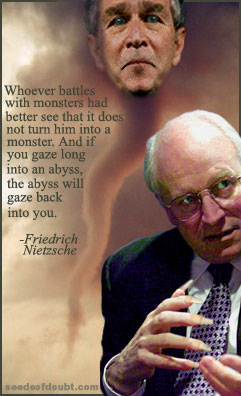
Throw Her Butt In Jail, For Contempt of Congress.


Who the hell does this woman think she is, anyhow?

Rice will not comply with House subpoena
By Klaus Marre
April 29, 2007


U.S. Secretary of State Condoleezza Rice made it clear Sunday that she does not plan to comply with a subpoena that the House Oversight and Government Reform Committee authorized this week.Panel Chairman Henry Waxman (D-Calif.) wants Rice to testify on the administration’s false claim that Iraq was seeking to acquire uranium from Niger. The congressman feels that Rice has not been responsive enough to repeated written requests for information on the issue.

However, the Secretary of State, when asked by ABC’s George Stephanopoulos why she would not comply with the subpoena to make her case, said that at issue is a separation of powers issue. Rice was making the rounds on the Sunday talk shows to discuss the war in Iraq and the subpoena.“I respect the oversight role of Congress, and I’m perfectly willing to continue to try to answer whatever questions Chairman Waxman may have about this very thoroughly investigated issue,” Rice said on CBS’ “Face the Nation.”

Waxman strongly disagrees with Rice’s claim that she has been answering his questions. Prior to the authorization of the subpoena, the lawmaker said he has written several letters to Rice in order to find out more about the “fabricated Niger plan,” adding that he did not receive the first response until March of this year.“Since then, I have received two additional letters,” Waxman said Wednesday. “The gist of the letters is that the Secretary either didn’t know about the forged evidence or forgot what she knew. Her staff has also suggested that the Secretary is too busy to answer these questions.”

(In accordance with Title 17 U.S.C. Section 107, this material is distributed without profit to those who have expressed a prior interest in receiving the included information for research and educational purposes. The Lantern has no affiliation whatsoever with the originator of this article nor is The Lantern endorsed or sponsored by the originator.)

....And The Truth Shall Set Us Free
Friday, April 27, 2007

Tenet Lambastes Cheney in New Book

April 27, 2007
Ex-C.I.A. Chief, in Book, Assails Cheney on Iraq
By
SCOTT SHANE and MARK MAZZETTI


WASHINGTON, April 26 — George J. Tenet, the former director of central intelligence, has lashed out against Vice President Dick Cheney and other Bush administration officials in a new book, saying they pushed the country to war in Iraq without ever conducting a “serious debate” about whether Saddam Hussein posed an imminent threat to the United States.

The 549-page book, “At the Center of the Storm,” is to be published by HarperCollins on Monday. By turns accusatory, defensive, and modestly self-critical, it is the first detailed account by a member of the president’s inner circle of the Sept. 11, 2001, terrorist attacks, the decision to invade Iraq and the failure to find the unconventional weapons that were a major justification for the war.

“There was never a serious debate that I know of within the administration about the imminence of the Iraqi threat,” Mr. Tenet writes in a devastating judgment that is likely to be debated for many years. Nor, he adds, “was there ever a significant discussion” about the possibility of containing Iraq without an invasion.

(Well, of course there weren't any discussions about containment or anything else other than invasion and occupation. They had been planning this for years.)

Mr. Tenet admits that he made his famous “slam dunk” remark about the evidence that Iraq had weapons of mass destruction. But he argues that the quote was taken out of context and that it had little impact on President Bush’s decision to go to war. He also makes clear his bitter view that the administration made him a scapegoat for the Iraq war.

A copy of the book was purchased at retail price in advance of publication by a reporter for The New York Times. Mr. Tenet described with sarcasm watching an episode of “Meet the Press” last September in which Mr. Cheney twice referred to Mr. Tenet’s “slam dunk” remark as the basis for the decision to go to war.

“I remember watching and thinking, ‘As if you needed me to say ‘slam dunk’ to convince you to go to war with Iraq,’ ” Mr. Tenet writes.

As violence in Iraq spiraled beginning in late 2003, Mr. Tenet writes, “rather than acknowledge responsibility, the administration’s message was: Don’t blame us. George Tenet and the C.I.A. got us into this mess.”

(Mr. Tenet, has it ever occured to you that the Clinton hating Bush White House, kept two people from the Clinton White House on: you and Norman Minetta? Why would they do that?

Who got most of the blame for 9/11? The CIA and the FAA, one department run by you, the other, under Minetta.

It stands to reason that you would be scapegoated for Iraq as well, that is one of the reasons you were kept on after 9/11. You were going to serve as a scape goat, one way or the other.


Mr. Tenet takes blame for the flawed 2002 National Intelligence Estimate about Iraq’s weapons programs, calling the episode “one of the lowest moments of my seven-year tenure.” He expresses regret that the document was not more nuanced, but says there was no doubt in his mind at the time that Saddam Hussein possessed unconventional weapons. “In retrospect, we got it wrong partly because the truth was so implausible,” he writes.

(Nobody wanted to hear the truth, it didn't fit their plans!)

Despite such sweeping indictments, Mr. Bush, who in 2004 awarded Mr. Tenet a Presidential Medal of Freedom, is portrayed personally in a largely positive light, with particular praise for the his leadership after the 2001 attacks. “He was absolutely in charge, determined, and directed,” Mr. Tenet writes of the president, whom he describes as a blunt-spoken kindred spirit.

(Hey George, have you never thought it odd that George W. Bush, who fought all the way to the Supreme Court to get into the White House, acted like he had no idea what to do once he got there. He seemed rather lazy, as I recall; fairly bored and unfocused.

He wanted tax breaks.

He got them. Given that there was a surplus, not many peoplle were going to throw a fit about that.

He launched "No Child Left Behind," with the help of Ted Kennedy, then did little to fund the program.

He was headed for one term.

Until 9/11.

After that, it was as if he had been launched, like a unguided missle.

The attack by Al Qaeda on Manhattan, if that was indeed what happened, could not have come as a surprise to Bush, Cheney, Rice or you. Isn't that right? But you got the blame, nevertheless. Still George W Bush defended you and kept you on, as CIA Director. That really indebted you to him, right?

Think, George!

But Mr. Tenet largely endorses the view of administration critics that Mr. Cheney and a handful of Pentagon officials, including Paul D. Wolfowitz and Douglas J. Feith, were focused on Iraq as a threat in late 2001 and 2002 even as Mr. Tenet and the C.I.A. concentrated mostly on Al Qaeda.

Oh ferchrissake, they were focused on Iraq before the Supremes put them in office!

Mr. Tenet describes helping to kill a planned speech by Mr. Cheney on the eve of the invasion because its claims of links between Al Qaeda and Iraq went “way beyond what the intelligence shows.”

“Mr. President, we cannot support the speech and it should not be given,” Mr. Tenet wrote that he told Mr. Bush. Mr. Cheney never delivered the remarks.

(The hell he hasn't said this. He still says it!)

Mr. Tenet hints at some score-settling in the book. He describes in particular the extraordinary tension between him and Condoleezza Rice, then national security adviser, and her deputy, Stephen J. Hadley, in internal debate over how the president came to say erroneously in his 2003 State of the Union address that Iraq was seeking uranium in Africa.

He describes an episode in 2003, shortly after he issued a statement taking partial responsibility for that error. He said he was invited over for a Sunday afternoon, back-patio lemonade by Colin L. Powell, then secretary of state. Mr. Powell described what Mr. Tenet called “a lively debate” on Air Force One a few days before about whether the White House should continue to support Mr. Tenet as C.I.A. director.

“In the end, the president said yes, and said so publicly,” Mr. Tenet wrote. “But Colin let me know that other officials, particularly the vice president, had quite another view.”

Surely, you have heard of good cop/bad cop?

He writes that the controversy over who was to blame for the State of the Union error was the beginning of the end of his tenure. After the finger-pointing between the White House and the C.I.A., he wrote, “My relationship with the administration was forever changed.”

No it wasn't. It just became obvious that you were going to be the fall guy, and this had been planned all along.

Mr. Tenet also says in the book that he had been “not at all sure I wanted to accept” the Medal of Freedom. He agreed after he saw that the citation “was all about the C.I.A.’s work against terrorism, not Iraq.”

He also expresses skepticism about whether the increase in troops in Iraq will prove successful. “It may have worked more than three years ago,” he wrote. “My fear is that sectarian violence in Iraq has taken on a life of its own and that U.S. forces are becoming more and more irrelevant to the management of that violence.”

Mr. Tenet says he decided to write the memoir in part because the infamous “slam dunk” episode had come to define his tenure at C.I.A.

He gives a detailed account of the episode, which occurred during an Oval Office meeting in December 2002 when the administration was preparing to make public its case for war against Iraq.

During the meeting, the deputy C.I.A. director, John McLaughlin, unveiled a draft of a proposed public presentation that left the group unimpressed. Mr. Tenet recalls that Mr. Bush suggested that they could “add punch” by bringing in lawyers trained to argue cases before a jury.
“I told the president that strengthening the public presentation was a ‘slam dunk,’ a phrase that was later taken completely out of context,” Mr. Tenet writes. “If I had simply said, ‘I’m sure we can do better,’ I wouldn’t be writing this chapter — or maybe even this book.”

Mr. Tenet has spoken rarely in public, and never so caustically, since stepping down in July 2004.

Asked about Mr. Tenet’s assertions, a White House spokesman, Gordon D. Johndroe, defended the prewar deliberations on Thursday. “The president made the decision to remove Saddam Hussein for a number of reasons, mainly the National Intelligence Estimate on Iraq and Saddam Hussein’s own actions, and only after a thorough and lengthy assessment of all available information as well as Congressional authorization,” the spokesman said.

(Bullshit!)

The book recounts C.I.A. efforts to fight Al Qaeda in the years before the Sept. 11 attacks, and Mr. Tenet’s early warnings about Osama bin Laden. He contends that the urgent appeals of the C.I.A. on terrorism received a lukewarm reception at the Bush White House through most of 2001.

(Well, of course they did. No Bushite had any interest in stopping the event they had long hoped for; a newPearl Harbor. As a matter of fact, they probably encouraged it.

“The bureaucracy moved slowly,” and only after the Sept. 11 attacks was the C.I.A. given the counterterrorism powers it had requested earlier in the year.

Mr. Tenet confesses to “a black, black time” two months after the 2001 attacks when, sitting in front of his house in his favorite Adirondack chair, he “just lost it.”

“I thought about all the people who had died and what we had been through in the months since,” he writes. “What am I doing here? Why me?” Mr. Tenet gives a vigorous defense of the C.I.A.’s program to hold captured Qaeda members in secret overseas jails and to question them with harsh techniques, which he does not explicitly describe.

Mr. Tenet expresses puzzlement that, since 2001, Al Qaeda has not sent “suicide bombers to cause chaos in a half-dozen American shopping malls on any given day.”

(Yeah, I have to admit, that has puzzled me too. A few well placed bombs in several Walmarts could have broken the economy fast. But no such attacks ever came. I wonder why?)

“I do know one thing in my gut,” he writes. “Al Qaeda is here and waiting.”

(Waiting for what, exactly? Instructions? From Whom?)

David E. Sanger contributed reporting from Washington, and Julie Bosman from New York.

(In accordance with Title 17 U.S.C. Section 107, this material is distributed without profit to those who have expressed a prior interest in receiving the included information for research and educational purposes. The Lantern has no affiliation whatsoever with the originator of this article nor is The Lantern endorsed or sponsored by the originator.)

....And The Truth Shall Set Us Free
Wednesday, April 25, 2007

Congress Ready To Paper Washington, With Subpoenas

Dems Vote Subpoenas in Widening Probes

LAURIE KELLMAN
AP April 25, 2007 11:08 PM EST Compare other versions »

WASHINGTON — Putting their congressional control to work, Democrats approved new subpoenas Wednesday _ and a grant of immunity _ for probes ranging from the prosecutor firings and White House political activities to President Bush's justification for the war in Iraq.
Democrats said the broad array of investigations represents a revival of Congress' role after six years of little oversight of the Bush administration by Republican lawmakers.

The White House is pushing back, refusing to allow officials to testify under oath about the firings and arguing that top officials _ including Secretary of State Condoleezza Rice, subject of one of the subpoenas _ already have answered questions about the administration's now-discredited claim that Iraq was seeking uranium for a bomb.

"I am beginning to wonder whether the White House has any interest in the American people learning the truth about these matters," said Senate Judiciary Committee Chairman Patrick Leahy, D-Vt.

Congress' effort isn't driven solely by Democrats. Republicans have barely restrained their disdain for Attorney General Alberto Gonzales' accounting of the firings, including his claims of a faulty memory.

Sen. Arlen Specter, ranking Republican on the Judiciary Committee, co-signed a letter with Leahy Wednesday urging Gonzales to freshen his memory and provide answers within a week.
"We are reviewing this request," said Justice Department spokesman Dean Boyd.

Sen. John McCain, R-Ariz., told reporters in New Hampshire as he officially declared his presidential candidacy that he would have more to say on Gonzales on Thursday. Then, he told CNN's Larry King that he was "very disappointed" in Gonzales' performance and, asked whether Gonzales should step down, said: "I think that out of loyalty to the president that that would probably be the best thing that he could do."

Congress was ramping up investigations of the White House on several fronts:

_The House Oversight and Government Reform Committee voted 21-10 to issue a subpoena to Rice to compel her testimony on the Bush administration's pre-war claims about Saddam Hussein seeking weapons of mass destruction.

_Next door, the House Judiciary Committee voted 32-6 to grant immunity from prosecution to
Monica Goodling, Gonzales' White House liaison, for testimony on why the administration fired eight federal prosecutors. The panel also unanimously approved _ but did not issue _ a subpoena to compel her to testify. In addition, the committee scheduled a May 10 hearing for Gonzales.

_Across Capitol Hill, Leahy's panel approved _ but did not issue _ a subpoena in the firings matter for Sara Taylor, deputy to Bush political adviser Karl Rove.

_The House oversight committee also issued subpoenas for the Republican National Committee for testimony and documents about White House e-mails on RNC accounts that are said to be missing. The RNC released a letter to the panel listing 37 White House officials who have RNC e-mail accounts, including Rove.

Gonzales, meanwhile, was trying to mend fences in his first visit to Capitol Hill since his punishing appearance before the Senate Judiciary Committee last week.

He met privately with Sen. Mark Pryor, D-Ark., who has contended Gonzales wasn't truthful with him about the dismissal of the U.S. attorney in Little Rock. The outreach didn't take.
"I reiterated with the attorney general, face-to-face, that I think he should resign," Pryor told reporters after the meeting. "I think it's the best thing for the Department of Justice and it's probably the best thing for him personally and the administration."

Lawmakers say they want to force into the open the story of why the eight U.S. attorneys were fired.

Pryor's harsh words on Gonzales were echoed by lawmakers in both parties, though Republicans tended to leave out the actual call for his resignation. Chuck Grassley, R-Iowa, noted a pragmatic concern: The waning months of the Bush administration complicate prospects for confirming a new attorney general.

"I'll be as vigilant as ever in overseeing the Justice Department and working with other senators, both Republicans and Democrats, for accountability from the attorney general and the department he leads," Grassley said.

On the uranium issue, Rice's allies maintained that she has for years answered Congress' questions under oath, as well as media inquiries, about her knowledge of Bush's claim about Iraq.

State Department spokesman Sean McCormack, traveling with Rice in Europe for NATO meetings, said department officials would try to answer the committee's questions, but he indicated Rice might not comply with a subpoena.

"Those matters are covered by executive privilege," McCormack said. "Those matters mean the questions that he has related to her tenure as national security adviser."

That position gives "us no choice but to proceed with a subpoena," said House Oversight Committee's chairman, Rep. Henry Waxman, D-Calif.

Even as he pressed ahead on Rice, Waxman postponed a vote on a subpoena for former White House Chief of Staff Andrew Card on the same issue. Waxman said White House Counsel Fred Fielding had made a compromise proposal worth pursuing: The committee will first talk to the White House office of administration about Card's knowledge.

On the prosecutor firings, the House Judiciary Committee approved two measures that would compel Goodling's testimony and grant her immunity from prosecution for what she says.
Some Republicans cautioned that immunity has tied the hands of prosecutors in the past, notably during the Iran-Contra affair. John Poindexter and Oliver North were granted immunity for congressional testimony, and later convictions were reversed _ ruled to have been based too much on that testimony.

At the Justice Department, Boyd would not speculate on whether giving Goodling immunity could hamper prosecutors should evidence of criminal activity surface.

(In accordance with Title 17 U.S.C. Section 107, this material is distributed without profit to those who have expressed a prior interest in receiving the included information for research and educational purposes. The Lantern has no affiliation whatsoever with the originator of this article nor is The Lantern endorsed or sponsored by the originator.)

....And The Truth Shall Set Us Free

Saturday, April 21, 2007

Don't Just Consider It, DO IT!

It is way past time for the truth to come out; All Of It


House Oversight Committee to consider Rice subpoena
By Susan Crabtree
April 20, 2007

The House Committee on Oversight and Government Reform will consider next week whether to issue subpoenas to get access to documents and testimony from the Bush administration, including the testimony of Secretary of State Condoleezza Rice.

With the scheduling of the panel hearing, Rep. Henry Waxman (D-Calif.) is upping the ante in his fight with the administration for access to information.

Waxman announced Friday that his panel will hold a business meeting next Wednesday to consider whether to issue four subpoenas for testimony and documents. According to the committee’s press release, the subpoenas are aimed at obtaining:

- Rice’s testimony regarding the fabricated claim that Iraq sought uranium from Niger and other pre-war intelligence issues;

- the testimony of former White House Chief of Staff Andrew Card regarding the leak of Valerie Plame Wilson’s covert identity and White House security procedures;

- Republican National Committee (RNC) documents related to possible violations of the Presidential Records Act and the Hatch Act by White House officials;

- and contacts between the White House and MZM, a federal contractor implicated in bribery charges.

Waxman’s most recent letters requesting the documents were sent to Card, RNC Chairman Mike Duncan and White House Counsel Fred Fielding on April 20. He also sent a letter to Rice on April 17.


....and the truth shall set us free.

Wednesday, February 28, 2007

Condi gets K.O.ed

On "Fox News Sunday" Feb. 25, Secretary of State Condoleezza Rice paralleled World War II with the state of Iraq when discussing what would happen if Congress were to revise the Iraq authorization:

We already know about her suggestion that the president could just ignore whatever congressional Democrats do about Iraq.

Just ignore Congress.

We know how that game always turns out. Ask President Nixon. Ask President Andrew Johnson.

Or ask Vice President Dick Cheney, who utterly contradicted Secretary Rice on Monday when he warned President Pervez Musharraf of Pakistan about what those mean congressional Democrats could do to his foreign aid.

All of this, par for the course.

But about what the secretary said regarding the prospect of Congress’ revising or repealing the 2002 authorization of the war in Iraq:

Here we go again! From springs spent trying to link Saddam Hussein to 9/11, to summers of cynically manipulated intelligence, through autumns of false patriotism, to winters of war, we have had more than four years of every cheap trick and every degree of calculated cynicism from this administration, filled with Three-Card Monte players.

But the longer Dr. Rice and these other pickpockets of a nation's goodness have walked among us, waving flags and slandering opponents and making true enemies — foreign and domestic — all hat and no cattle all the while, the overriding truth of their occupancy of our highest offices of state has only gradually become clear.

As they asked in that Avis commercial: "Ever get the feeling some people just stopped trying?"
Then-Defense Secretary Donald Rumsfeld thought he could equate those who doubted him with Nazi appeasers, without reminding anybody that the actual, historical Nazi appeasers in this country in the 1930s were the Republicans.

Vice President Cheney thought he could talk as if he and he alone knew the “truth” about Iraq and 9/11, without anyone ever noticing that even the rest of the administration officially disagreed with him.

The president really acted as if you could scare all of the people all of the time and not lose your soul — and your majority — as a result.

But Secretary of State Rice may have now taken the cake. On the Sunday morning interview show “Of Broken Record” on Fox, Dr. Rice spoke a paragraph, which if it had been included in a remedial history paper at the weakest high school in the nation would've gotten the writer an "F" — maybe an expulsion.

If Congress were now to revise the Iraq authorization, she said, out loud, with an adult present: "… it would be like saying that after Adolf Hitler was overthrown, we needed to change, then, the resolution that allowed the United States to do that, so that we could deal with creating a stable environment in Europe after he was overthrown."

CONTINUED
1 2 3 Next >

...and the truth shall set us free