Tomgram: De la Vega, Has Libby Learned Nothing?
Former federal prosecutor Elizabeth de la Vega has been writing about the case of outed CIA agent Valerie Plame for this site since the summer of 2005. The story itself began back in July 2003 with a
New York Times op-ed by Plame's husband, former Ambassador Joseph Wilson, that called into question one of the many exaggerations, fabrications, and manipulations with which the Bush administration took a fear-filled and cowed Congress and a fear-filled populace on a bum's rush to its war of choice. In Wilson's case, it was the famed
16 words ("The British government has learned that Saddam Hussein recently sought significant quantities of uranium from Africa…") that made it into the President's 2003 State of the Union speech about Saddam Hussein's supposed search for yellowcake uranium in Africa for the Iraqi nuclear program that had not existed for years. This was part of the supposed evidence which allowed top officials, especially
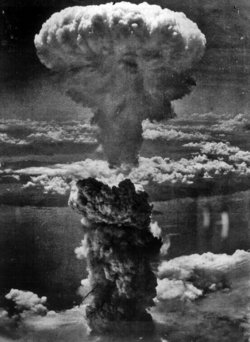
Vice President Cheney, to put the proverbial "mushroom cloud" over American cities before the invasion of Iraq. (Or as then-National Security Advisor Condoleezza Rice so famously
said: "[W]e don't want the smoking gun to be a mushroom cloud." The subsequent rush of the highest officials of this administration to smear Wilson (through his CIA agent wife and by other means) was an early indication of post-invasion panic in White House ranks -- and of an administration's collective desire to make a harsh example of one person ready to speak publicly in order to staunch any future bleeding on the domestic front.
This Tuesday, Vice President Cheney's former right-hand man, I. Lewis Libby, is to receive legal justice for his role in covering up these activities. As de la Vega indicates below, given the enormity of what his boss and others did -- and a glance at any of those little boxes inside most American papers with the names of dead American soldiers offers but a glimpse of the mayhem and carnage they let loose -- this is a modest moment indeed. De la Vega in her remarkable book
United States v. George Bush et al., a
"hypothetical indictment" of the President, Vice President and three top advisors, and seven days of "grand jury testimony" on the way this administration conspired to defraud us into war, went after the largest target of all. (By next year, with the book being transformed into both a movie and a play, her "indictment" may be part of American life.) In the meantime, she makes sense of what we should -- and should not -- expect Tuesday of the Libby sentencing. Tom
Sentencing for DummiesThe Fate of I. Lewis LibbyBy Elizabeth de la Vega
If the memorandum filed by defense attorneys in anticipation of former top White House adviser I. Lewis "Scooter" Libby's June 5th sentencing is any indication, it appears that Libby -- one of the highest White House officials ever convicted of a felony -- has learned precisely nothing from his trial and conviction on charges of false statements, obstruction of justice, and perjury.
Libby's lawyers admit -- because they have to -- that their client, a man with three decades of executive-level federal government service, disseminated classified information about the status of CIA Agent Valerie Plame Wilson in response to public criticism of the Bush administration by her husband, former ambassador Joseph Wilson. They nevertheless insist that this, at best, reckless (and, far more likely, intentional) act is not only not illegal, but not even wrong.
Unfortunately for Libby, this in-your-face position also has a certain shoot-yourself-in-the-foot quality. Libby is arguing for a probationary sentence, which is considerably more lenient than that called for by the Sentencing Guidelines. (See lesson one below.) An essential factor every judge must consider in deciding whether to depart from the guidelines to impose such a light sentence is whether it would sufficiently deter others from similar misconduct.
Having aggressively argued that there was neither crime, nor misconduct, how do Libby's lawyers then address the issue of deterrence? They
argue that Libby has experienced a "very public fall from grace" and that this "dire consequence" alone would be enough to "warn the public -- and high ranking government officials in particular -- that it is important to take FBI and grand jury investigations very seriously." This is an exquisite expression of the entitlement and arrogance that spawned the administration's smear campaign against Joseph Wilson in the first place. It could only be more pointedly evocative of utter contempt for the rule of law if it were followed by a sneer emoticon.
If Libby and his loyal followers -- including former Law and Order District Attorney Fred Thompson who appears to be taking the creative approach of launching his presidential campaign with an
attack on prosecutions for perjury (those wacky soft-on-crime Hollywood types!) -- have learned nothing from this case, what about the rest of us? What lessons might we learn from Special Counsel Patrick Fitzgerald's investigation into the outing of Valerie Plame Wilson?
Lesson One: Federal Sentencing for Dummies
This lesson is designed for those of you who are not lawyers or otherwise inclined to wade through the United States Sentencing Guidelines in order to understand the issues that Judge Reggie Walton has to decide before sentencing Scooter Libby.
Here is all you need to know:
In federal court, sentences are determined using a system of guidelines that has two main components: a defendant's criminal history and an "offense level" based on the nature of the crimes for which he was convicted. After someone is convicted of a crime, a probation officer prepares a report that lays out a preliminary calculation of these factors, which results in a recommended sentencing range. The probation officer also identifies possible grounds for downward or upward departures from that range. The government and the defense then argue about the findings and calculations in the report, submit memos and make oral presentations, after which the judge decides what sentence to impose. Judges don't have to follow the guidelines, but they usually do.
Everyone in the case thus far -- the probation officer, the defense attorneys, and the prosecutors -- agrees that the base offense level for Libby is 15 to 21 months. The Special Counsel is arguing, however, that, under the federal sentencing guidelines, the court should increase this range because Libby's perjury and obstruction of justice interfered with an investigation into possible violations of the Intelligence Identities Protection Act and the Espionage Act. If the court accepts this argument, Libby could receive a sentence ranging from 30 to 37 months.
The defense, on the other hand, is arguing that the judge should not follow the guidelines at all. Instead, they say, Libby should merely be sentenced to probation because:
(1) he has an outstanding record of government service;
(2) he will lose his law license;
(3) he and his family have suffered, financially and otherwise, as a result of the prosecution;
(4) his conduct was an aberration;
(5) he is unlikely to commit crimes in the future.
Given that, as the government points out, Libby used his position in the White House to commit the crime for which he was convicted; that he has not used his law license for many years and would likely never have to again; that the families of all defendants' suffer and that, unlike most defendants, Libby has a massive legal defense trust fund; that he committed his crime not once, but four times over a period of many months; and that doesn't think he did anything wrong, I suspect the judge will not be giving Libby probation. Indeed -- for what it's worth -- I consider it far more likely that he will receive a sentence of approximately 30 months.
Lesson Two: Why the Sentence Libby Receives is the Least Significant Aspect of the Entire CIA Leak Investigation
The case of United States v. I. Lewis Libby was simultaneously the repository of enormous hopes among critics of the Bush administration (who, like myself, longed to see Special Prosecutor Fitzgerald crack open the whole White House rush to war against Iraq) and the target of remarkable vitriol on the part of administration supporters. As it turned out, the wishes and fears of both sides were more a reflection of what the case was not than of what it actually was. Certainly, the investigation and prosecution of Libby had the potential to reveal information that might have had significant political consequences, but the criminal proceedings themselves were never going to be the agent of such change. For that we needed -- and still need -- Congress.
Because of this almost universal disconnect over the case, I would not be surprised to find that, even if Judge Walton imposes a sentence of 37 months -- which I believe would be entirely warranted -- many people, particularly those who have most ardently supported the effort, will find the event anticlimactic and vaguely dispiriting.
I make this prediction in part because such is the nature of sentencing proceedings. Having participated in hundreds of sentencings, I've found nearly every one to be dispiriting at some level. Strangely -- especially given that I was there as a prosecutor -- I often felt sorry for the defendant and, even more often, sympathized with the defendant's family and friends. At the same time, I was always heartbroken by the effects of the crime on the victims and knew that the pain they had been caused was not going to end simply because the defendant was heading off to prison. Sentencings have an aura of finality -- and simplicity -- that is invariably more illusory than real.
An even greater illusion, however, is the idea that any sentencing, any individual criminal prosecution, or any individual prosecutor could have a galactic impact on our society (no less, in this case, on the fall of the House of Bush). Every prosecutor knows this fact -- and is occasionally more humbled by it than he or she might wish to be -- but if you would like to test the proposition, ask yourself these questions: A. Who prosecuted Al Capone? B. Who prosecuted Timothy McVeigh? C. Who prosecuted the Unabomber? (Answers: A.
George E.Q. Johnson; B.
George Hartzler; C.
Robert Cleary, Stephen Freccero, and Steven Lapham.)
This in no way minimizes the importance of the Libby case, nor does it lessen the accomplishments of the able team that prosecuted it. On the contrary, Special Counsel Patrick Fitzgerald himself has repeatedly emphasized this very point, most recently in the Special Counsel's Sentencing Memo filed on May 25th. The Libby prosecution served to vindicate, he wrote, "a principle fundamental to preserving our judicial system's independence from politics: that any witness, whatever his political affiliation, whatever his views on any policy or national issue, whether he works in the White House or drives a truck to earn a living, must tell the truth when he raises his hand and takes an oath in a judicial proceeding, or gives a statement to federal law enforcement officers." That is not an insignificant public interest -- indeed it is critically important -- but it is a limited one.
It is, moreover, not even remotely equivalent to the interest the public has in ensuring -- no, demanding -- that Congress rein in the executive abuse of power that spawned the Iraq War, and so the smear campaign against Joseph Wilson and Valerie Plame Wilson. Indeed, it is worse than illusory; it is actually quite dangerous in the long-term for the public to believe that the work of prosecutors and prosecutions can substitute for the work of Congress.
No, I am not decrying the "criminalization of politics" (as those on the right are so fond of doing). There are times -- and this is one example -- when our government officials have committed crimes and must be prosecuted. Nonetheless, the prosecution of those crimes, however expertly done, is a focused, precise task. To expect a federal prosecutor to remedy the gravely dysfunctional government that we currently have through one, or even many, criminal prosecutions is like expecting an orthopedic surgeon to cure a patient's multiple organ failure by setting a broken arm.
Elizabeth de la Vega is a former federal prosecutor with more than 20 years of experience. During her tenure, she was a member of the Organized Crime Strike Force and Chief of the San Jose Branch of the U.S. Attorney's Office for the Northern District of California. Her pieces have appeared in the Nation magazine, the Los Angeles Times, and Salon. She writes regularly for Tomdispatch.com. She is the author of United States v. George W. Bush et al., which has been optioned for both a play and a movie (scheduled to begin production in the summer of 2007). She may be contacted at ElizabethdelaVega@Verizon.net.
Copyright 2007 Elizabeth de la Vega (In accordance with Title 17 U.S.C. Section 107, this material is distributed without profit to those who have expressed a prior interest in receiving the included information for research and educational purposes. The Lantern has no affiliation whatsoever with the originator of this article nor is The Lantern endorsed or sponsored by the originator.)
....And The Truth Shall Set Us Free