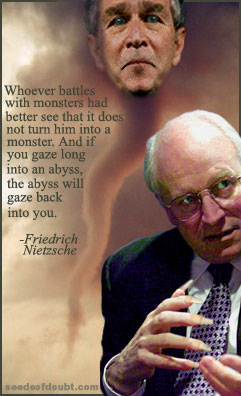
Funny, isn't it, that over here, in the "land of the free," Bush has no problem at all keeping non-violent protests of our TeeVee sets?
The corporate-whore media does it for him.
As TV Coverage Feeds Protests, Musharraf Reacts
By Griff Witte
Washington Post Foreign Service
Monday, June 4, 2007; A01
HARIPUR, Pakistan -- Every day, Taj Mohammed Abbasi wheels his cart through dusty streets, selling the oranges, guavas and litchis that are the pride of this rural outpost in the shadow of the Himalayan foothills.
But what he's seen recently on television motivated him this weekend to take to the streets for a different reason: to join a movement with the audacious goal of ousting the military-led government and restoring democracy to Pakistan.
"Watching television, I have become very angry," said Abbasi, 33, swatting flies from his cart. "I am not a political person. I have not been to a lot of rallies. But this time, definitely, I am going."
Pakistan might be in the midst of its first televised revolution. For nearly three months, a handful of fledgling independent stations have been broadcasting minute-by-minute coverage of what at first seemed a relatively obscure issue: the suspension of Pakistan's chief judge by the president, Gen. Pervez Musharraf.
Since then, Pakistanis nationwide have been transfixed by live coverage of police beating lawyers, pro-Musharraf groups firing assault rifles at demonstrators and the chief justice speaking to ever-larger and more boisterous audiences about the dangers of autocratic rule.
As the cameras have rolled, opposition to Musharraf has surged, and he is considered more vulnerable now than at any time in his eight years in office. Even in rural areas where poverty is high, residents have gathered in hotels and barbershops around the few television sets available and watched the brewing crisis play out live.
Here in Haripur -- an hour's drive north of the capital, Islamabad, but a world away from its modern conveniences -- residents came out by the thousands on Saturday to demand that Musharraf step aside and allow elections to restore civilian rule.
Stung by the criticism, Musharraf has reacted by cracking down on what had been the government's signature defense against charges of authoritarianism: the independent television news networks.
The country's half-dozen networks all sprung up under his watch, and Musharraf has repeatedly bragged to the world about his efforts to free Pakistani television from state control and censorship for the first time in the country's history. But with his government teetering, Musharraf, a key U.S. ally, is threatening the networks' very existence.
"He allowed the genie out of the bottle. But he didn't realize how big it could become. Now he's trying to put it back," said Talat Hussain, director of news and current affairs for one of the channels, Aaj Television.
Aaj, along with others, has come under intense pressure in recent days to pull programming off the air and to cancel live coverage of opposition rallies. Aaj has continued to broadcast, but its transmission is being blocked throughout much of the country.
"I have no illusions about it," Hussain said. "They're going to shut us down."
Ayaz Amir, a political commentator who hosts a call-in program on rival channel ARY Oneworld, said his show was canceled this past week because of government pressure. "I've been branded as a person who's not favorably disposed to the government," he said.
Government officials deny they are censoring the news media. They say they are simply enforcing regulations that have been on the books for years but have often been ignored, including a requirement that stations get permission before they broadcast live.
"The independence of the media is something we take pride in," said Information Minister Mohammed Ali Durrani. "We'll take care of their independence."
Musharraf has made no secret of his displeasure with the way the controversy over the chief justice has been covered, and his top aides have accused the news media of exploiting the issue for ratings gains.
Last week, Durrani warned journalists against criticizing the army, an institution that has historically been revered in Pakistan but is increasingly attacked for denying the country a chance at civilian rule eight years after a military-led coup elevated Musharraf to power.
Durrani's remarks came after the independent channels broadcast marathon coverage of an anti-Musharraf rally at which demonstrators chanted slogans such as, "The generals are traitors" and "Save the country -- take Musharraf's skin off."
Since that rally, several of the channels have toned down their coverage of the crisis, and there is widespread speculation that they made deals with the government in order to continue broadcasting.
Until recent months, Musharraf had displayed an adeptness at using the media to his advantage -- giving occasional interviews and staging elaborate press events to showcase government accomplishments. The tactics worked: The president enjoyed widespread popularity and was considered virtually invincible.
But the chief justice, Iftikhar Mohammed Chaudhry, loomed as a potential obstacle because he was expected to rule on cases that could complicate Musharraf's plans to get himself elected for another five-year term by a lame-duck parliament.
On March 9, Musharraf invited cameramen to a meeting at which he expected Chaudhry to resign under pressure for alleged abuses of office. Instead, Chaudhry refused. The image of the judge moments before he stood up to the uniformed president became the first icon of the controversy.
The next came days later, when police raided Geo television's office in Islamabad as the station tried to film protesters demonstrating against Chaudhry's suspension. Tear gas filled the office, and police began beating journalists with batons, but the cameras continued to roll.
Two months later, in Karachi, Aaj's office came under attack as demonstrators clashed in the streets outside in violence that would ultimately claim more than 40 lives. During six hours of live coverage, Aaj's anchors repeatedly called for help from the police, to no avail, on a day when government security forces were widely blamed for standing by as the city burned.
A note on the Geo Web site Sunday said: "The government has blocked the transmission of the Geo News TV channel across the country due to the reasons best known to them. . . .
"The citizens, social and political circles have condemned the ban on transmission of Geo News and they have demanded of the government to immediately lift ban on the transmission of the Geo News and give complete freedom to media in the country," it said.
The chief justice and his supporters have used television to their advantage, staging exuberant, day-long parades from one city to the next, earning them hours of continuous coverage.
By contrast, political observers say, the government has tried to use force and intimidation to end the controversy, but has consistently misjudged how its efforts would play on television. As a result, Musharraf's problems have only intensified.
"What they did not take into account was that the crisis was going live to every bloody Pakistani household," said Aamer Ahmed Khan, Pakistan editor of the BBC World Service and a journalist here for more than two decades. "That is what is making them nervous now."
(In accordance with Title 17 U.S.C. Section 107, this material is distributed without profit to those who have expressed a prior interest in receiving the included information for research and educational purposes. The Lantern has no affiliation whatsoever with the originator of this article nor is The Lantern endorsed or sponsored by the originator.)
....And The Truth Shall Set Us Free
Showing posts with label Pakistan. Show all posts
Showing posts with label Pakistan. Show all posts
Monday, June 04, 2007


Saturday, June 02, 2007
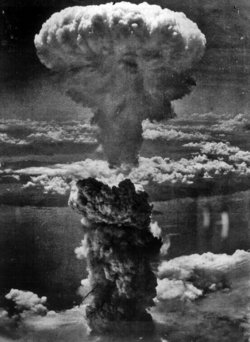
Bush Paves Way For The Bomb
....in terrorist's hands
Bush policy could not have had a different outcome or a worse one. Can't help but wonder, do these people, the Bushites, think at all?
How Bush Risks an Islamist Bomb
By Ivan Eland
May 30, 2007
Editor's Note: Among the many catastrophes surrounding George W. Bush's Middle East wars is possibly the bitterest irony of all -- that he is laying the groundwork for radical Islamists to get an atomic bomb via the collapse of Pakistan's pro-U.S. dictator Pervez Musharraf.
In this guest essay, the Independent Institute's Ivan Eland looks at how Bush's bungled policies in Afghanistan and Iraq are leading inexorably to an even worse disaster:
The Bush administration has failed to capture or kill Osama bin Laden or to win the wars in Afghanistan and Iraq. Now, the administration has also missed the chance to maintain a stable nuclear-armed Pakistan.
Like the U.S. policy toward the Shah’s Iran in the 1960s and 1970s, the Bush administration, despite a rhetorical commitment to spread democracy around the world, has put all of its eggs in the basket of an autocrat unlikely to survive—in this case, Pakistani President Pervez Musharraf.
Although Musharraf has used the U.S. war on terror to play the United States like a fiddle, the Bush administration believes there is no better alternative. Unfortunately, backing Musharraf could create a nuclear-armed Pakistan controlled by radical Islamists.
Unfortunately, Pakistan probably has already been “lost,” and U.S. policy has played an important role in its demise. U.S. policymakers have repeatedly underestimated the consequences of the deep unpopularity engendered by profligate U.S. government meddling in the affairs of other countries.
In Iran, although the Shah’s government was brutal, the regime also became so identified with its unpopular U.S. benefactor that the United States became a major contributing factor in its collapse and replacement with a militant and enduring Islamist substitute.
The Bush administration, with its macho bravado, has had a tin ear for the ramifications of anti-U.S hatred. After 9/11, instead of using the attacks as a justification to go after Saddam Hussein’s Iraq, the Bush administration had the opportunity to eliminate the Taliban in Afghanistan, take full advantage of Musharraf’s limited-time offer to give the U.S. military free reign in Pakistan to hunt down bin Laden and al Qaeda, and then withdraw from the region.
Instead, the Bush administration allowed mission creep to take its eyes off the prize of taking down al Qaeda. The U.S. mission in Afghanistan turned to nation-building, counterinsurgency, and cutting off the drug trade. The continued occupation of Afghanistan by non-Muslim forces and the close U.S. support for the dictator Musharraf in neighboring Pakistan, predictably revved up Pakistani Islamic militants and gradually turned them against his regime.
In an attempt to discreetly court these militants to support his government and to maintain the flow of U.S. military aid to ostensibly fight them, Musharraf allowed these groups to operate in the wild tribal regions of western Pakistan on the Afghan border and even reached a truce with them to withdraw the Pakistani government’s military forces from these areas. This wink and nod policy has allowed both al Qaeda and the militant Taliban to recover and step up attacks from these safe havens.
Given Musharraf’s unenthusiastic pursuit of al Qaeda in Pakistan, why does the United States continue to support him? The answer is mainly a fear of “instability”—read, any change of leadership in a nuclear weapons state.
The United States fears that the only alternative to Musharraf in a nuclear-armed Pakistan is the Islamic militants; but this outcome is actually more likely if the unpopular United States continues to zealously back Musharraf. At the same time Musharraf’s popularity has faded. He has faced mass protests across Pakistan for his increased despotism and his suspension of the country’s chief justice.
Musharraf feared that the judge, Iftikhar Mohammed Chaudhry, might issue rulings that would interfere with his attempt to have the parliament elect him to another five-year term. In addition, several former Pakistani generals have talked openly about overthrowing him in a coup.
But it may be too late to control a coup and reestablish military rule. The Islamists have been strengthened by Musharraf’s suppression of alternative non-Islamic opposition parties; Musharraf has said that their leaders—exiled former prime ministers Benazir Bhutto and Nawa Sharif—will not be allowed to return for upcoming parliamentary elections.
The Bush administration should change policy and end the occupation of Afghanistan, which would cool the Taliban resurgence in Afghanistan and the Islamic militancy in Pakistan. In addition, the United States should threaten to cut off aid to Pakistan unless Musharraf and his intelligence services make a genuine attempt to capture or kill bin Laden.
With a cooling of militant Islam in the region, Musharraf should have more leeway to pursue bin Laden without an Islamist backlash. Finally, the United States should press Musharraf to genuinely open Pakistani elections to non-Islamist parties and allow their leaders to return from exile. These actions would further erode support from the Islamist radicals.
Unfortunately, keeping the Islamists around, but contained, has been good for the autocratic Musharraf regime. The problem is that the instability caused by this policy can no longer be contained.
Like the Shah of Iran, Musharraf must use increased violence to put down popular protests, thus further fueling the spreading uprisings. The Shah’s Iran and Pakistan have one important difference, however: Pakistan has nuclear weapons.
Tragically, the Bush administration may eventually give the world an Islamist bomb.
Ivan Eland is Director of the Center on Peace & Liberty at The Independent Institute and Assistant Editor of The Independent Review. Dr. Eland has been Director of Defense Policy Studies at the Cato Institute, Principal Defense Analyst at the Congressional Budget Office, Evaluator-in-Charge (national security and intelligence) for the U.S. General Accounting Office, and Investigator for the House Foreign Affairs Committee.
(In accordance with Title 17 U.S.C. Section 107, this material is distributed without profit to those who have expressed a prior interest in receiving the included information for research and educational purposes. The Lantern has no affiliation whatsoever with the originator of this article nor is The Lantern endorsed or sponsored by the originator.)
....And The Truth Shall Set Us Free
Subscribe to:
Comments (Atom)